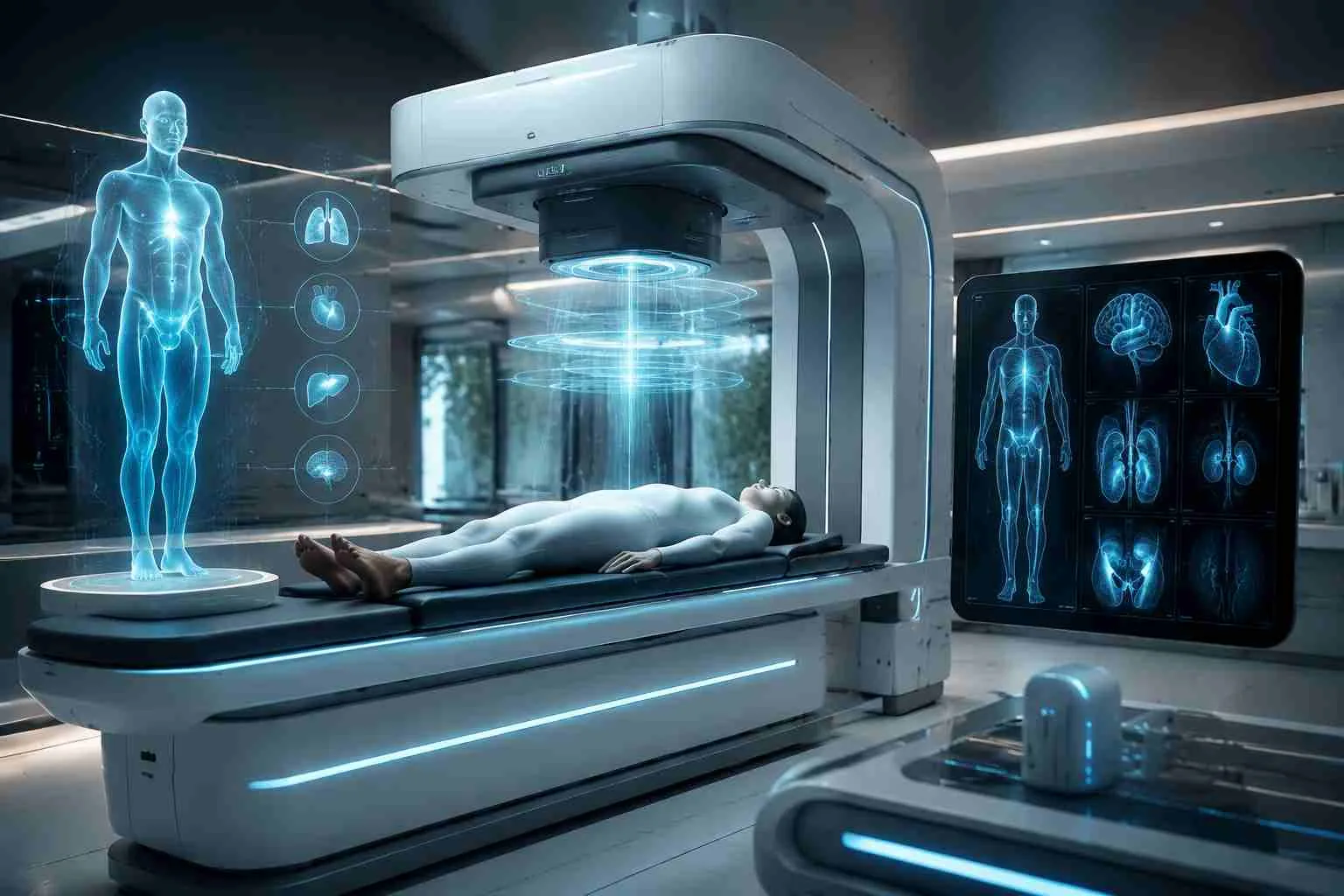
When Midjourney first entered the public consciousness, it did so with a simple, almost poetic premise: type a few words, and watch a machine conjure an image out of nothing. That idea turned the San Francisco company into a cultural phenomenon, a go-to tool for artists, designers, and curious minds around the world. But on June 18, 2026, Midjourney's CEO David Holz stood in front of an audience and unveiled something that had nothing to do with pixels, prompts, or digital art. He introduced a machine that looks inside the human body — and he is betting it will change medicine forever.
The device is called the Midjourney Scanner. It is a full-body ultrasound imaging system that submerges a person in a shallow pool of warm water and uses hundreds of thousands of sound wave sensors to construct a three-dimensional map of everything beneath the skin — muscles, organs, fat, bone — without radiation, without magnetic fields, and without the clinical anxiety of a hospital appointment. According to Midjourney's official announcement, the experience is designed to feel less like a medical procedure and more like a visit to a luxury spa.
The announcement sent shockwaves through both the technology and healthcare industries. It also raised serious questions — about what the device can actually do today, what it cannot, and whether a company famous for generating dreamlike images is truly prepared to take on one of the most heavily regulated industries on Earth.
From Text-to-Image to Sound-Through-Body: The Pivot Nobody Saw Coming
Midjourney had been showing signs of fatigue in its core market. The AI image generation space — once dominated by the company alongside early rivals — had been increasingly crowded by Google, OpenAI, and a wave of well-funded startups. As PetaPixel noted, Midjourney had largely been surpassed in the AI image world by tech giants who had moved in with massive compute advantages and distribution networks it could not match.
The company responded not by doubling down on images, but by asking itself an existential question. According to Engadget, Midjourney reached a moment where leadership began asking: "How do we want to be different? What do we want to become?" The answer, apparently, was medicine.
In a blog post titled "A New Era for Midjourney," the company described the Scanner project as "a little weird and a little crazy, but also spectacular and filled with hope." That framing — simultaneously self-aware and visionary — has become something of a Midjourney trademark. Whether it translates from the world of AI art into the world of clinical-grade medical imaging is the central question the company now must answer.
Inside the Machine: How the Midjourney Scanner Actually Works
The technology behind the Scanner belongs to a category called Ultrasound Computed Tomography, or USCT — a technique with roots stretching back to the 1950s. Unlike the handheld ultrasound probe that a technician moves across a patient's skin in a hospital, USCT surrounds the body with a ring of transducers submerged in water, firing sound pulses from every angle at once. The returning echoes are captured and fed into a reconstruction algorithm that assembles a full volumetric image of the body's interior.
The experience Midjourney has designed around this technology is deliberately sensory. A user steps onto a motorized platform. The platform descends slowly — at roughly 5 centimeters per second — into a pool of warm water. As the body passes through the transducer ring, sound waves travel through tissue from every direction, generating terabytes of acoustic data per second. Midjourney describes the output as a sub-millimeter resolution, full-body 3D anatomical map — one that, the company says, resembles an MRI scan but is produced at nearly a hundred times the speed, with no radiation and no magnetic field.
The current prototype processes approximately 17 gigabytes of raw acoustic data per second. Each cross-sectional image slice requires roughly 40 gigabytes of data to reconstruct. The company's own description likens the data volume to more than 500 hours of high-definition video generated every single second of scanning time.
The Butterfly Network Deal: The Chip That Makes It Possible
The hardware core of the Midjourney Scanner was not invented by Midjourney. In November 2025, the company signed a co-development and exclusive licensing agreement with Butterfly Network (NYSE: BFLY), a publicly traded medical device company that pioneered the use of semiconductor chips in ultrasound imaging.
According to Butterfly Network's official commentary on the announcement, the current scanner prototype incorporates 40 Ultrasound-on-Chip™ imaging modules per system. What makes these chips remarkable is that Butterfly replaced traditional piezoelectric crystal elements — the standard acoustic components found in conventional ultrasound probes — with capacitive micromachined ultrasonic transducers, or CMUTs, built directly onto standard silicon wafers using the same semiconductor fabrication techniques used to make computer processors.
Each chip contains up to 9,000 individual CMUT elements. The result is a transducer array that is both extraordinarily dense and manufacturable at scale — a crucial advantage for any company that wants to deploy tens of thousands of devices worldwide. The deal filed with the SEC commits Midjourney to a $15 million upfront payment, $10 million annually in licensing fees over five years, plus milestone and revenue-sharing payments — totaling up to $74 million.
In the current hardware configuration, the scanner operates approximately 8,960 active transducer channels and requires around 2 petaflops of computing power to process the data in real time. Future generations are expected to incorporate substantially more imaging modules, reflecting the platform's planned evolution toward the speeds and image quality Midjourney has publicly promised.
The 60-Second Claim vs. the 20-Minute Reality
Let us be direct about the most important distinction in this story, because it matters enormously for how the Midjourney Scanner should be understood right now.
The company's headline promise — a complete full-body scan in 60 seconds — is a target, not a current capability. As TechTimes reported, the existing prototype takes approximately 20 minutes per scan and, as of the June 18 announcement, had been used on roughly a dozen people. The bottleneck is data throughput: the system cannot yet move information between the transducer array and the reconstruction computing cluster fast enough to complete a full-body image in under a minute.
David Holz acknowledged as much at the launch event, stating that the company is "not even using any AI in the imaging pipeline yet — just really cool hardware and software." That admission deserves emphasis. Midjourney — a company that built its entire identity and revenue base on artificial intelligence — has constructed a medical scanner that currently operates with no AI component whatsoever in the image generation process.
What the roadmap looks like, according to PYMNTS:
- Next 12 months: Algorithm refinement, hardware iteration, research trials, second-generation design
- 2028: Third-generation scanner with fully custom silicon — designed and manufactured by Midjourney — promising image quality described as "night-and-day" compared to current output
- 2031: 50,000 units deployed globally, capacity for 1 billion scans per month
The gap between the 12-person prototype of today and the billion-scans-per-month ambition of 2031 is not just a technical challenge. It is a regulatory, clinical, and operational mountain that no amount of computing power alone can summit.
Why Midjourney Is Building Spas, Not Hospitals



One of the most strategically revealing details of the Midjourney Medical announcement is not the technology itself — it is where the company plans to deploy it. Not in radiology departments. Not in medical clinics. In spas.
The first Midjourney Spa is planned for Union Square in San Francisco, with an expected opening at the end of 2027. According to Engadget, the facility will cover approximately 25,000 square feet and house 10 scanners alongside hot tubs, saunas, and cold plunge pools. The scan, Midjourney says, is designed to be "a side effect" of the spa experience — something casual, ambient, and unthreatening.
This is not just a branding decision. It is a regulatory strategy. By positioning the Scanner as a wellness service rather than a diagnostic medical device, Midjourney can operate under the FDA's January 2026 General Wellness Policy for low-risk devices, which allows non-invasive physiologic measurement tools to function without full medical device clearance, provided they make no disease-related claims. Companies like Prenuvo and Ezra have successfully used this regulatory lane to offer whole-body MRI scans directly to consumers, bypassing the traditional prescription and referral system.
What the Scanner will officially provide, therefore, is body composition data — detailed maps of muscle mass, fat distribution, organ volume, and structural anatomy — without asserting that it detects, treats, or prevents any specific condition. If something unexpected shows up in a scan, the responsibility for follow-up lies with the user and their physician, not with Midjourney Medical.
Holz has stated that the company has begun discussions with the FDA and intends to pursue incremental diagnostic clearance over time, starting with the third-generation device expected in 2028.
The Science Nobody Is Talking About: What Happens When You Scan Everyone
The medical literature on mass screening of asymptomatic, healthy populations has produced a consistent and sobering body of evidence — one that Midjourney's announcement does not address, and that anyone evaluating the Scanner's potential impact should understand clearly.
When healthy people undergo whole-body imaging, between 20% and 40% of scans reveal what radiologists call incidental findings — internal anomalies that were not the reason for the scan and whose clinical significance is uncertain. Of those findings, only 5% to 15% ultimately require any medical intervention. The vast majority are benign variations, harmless cysts, or structural features that are present in the body but will never cause any problem.
The trouble is that every incidental finding must be either acknowledged, investigated, or dismissed. That process requires clinical decisions, follow-up imaging, specialist consultations, and sometimes invasive procedures — most of which confirm that the patient is fine. University of Michigan radiologist Matthew Davenport has documented that 15% to 30% of all adult imaging already contains at least one incidental finding. Overdiagnosis researcher H. Gilbert Welch has described the downstream consequences of whole-body screening programs as a potential public health hazard — one in which patients are harmed not by disease, but by the anxiety, procedures, and costs triggered by findings that required no intervention.
At Midjourney's stated ambition of one billion scans per month, the math becomes staggering:
| Scenario | Monthly Scans | Estimated Incidental Findings | Requiring Intervention |
|---|---|---|---|
| Conservative (20% finding rate) | 1,000,000,000 | 200,000,000 | 10,000,000 – 30,000,000 |
| Moderate (30% finding rate) | 1,000,000,000 | 300,000,000 | 15,000,000 – 45,000,000 |
| High (40% finding rate) | 1,000,000,000 | 400,000,000 | 20,000,000 – 60,000,000 |
None of this analysis assumes the Midjourney Scanner produces poor-quality images. It assumes the device works exactly as promised — and applies what population-level imaging research consistently predicts. The company's claim that broad early detection scanning could "prevent 30% of all deaths and cut 50% of healthcare costs" is not supported by any peer-reviewed evidence cited in its announcement materials.
The Team Behind the Vision — and the Weight of What They're Taking On
The hardware project is led by Ahmad Abbas, Midjourney's head of consumer hardware, who joined the company in late 2023 after a career at Apple that included hardware engineering work on the Vision Pro. According to Engadget, the team working on the Scanner consists of just nine people.
That is a remarkably small group to take on a challenge of this magnitude. FDA diagnostic clearance for a novel medical imaging device typically requires multi-year clinical trials, thousands of patient subjects, rigorous safety and efficacy data, and deep regulatory expertise. Midjourney has none of that experience — though it has, notably, chosen a path that avoids requiring it in the near term by entering as a wellness provider rather than a medical device manufacturer.
The Scanner is one of eight active projects at Midjourney — four in hardware, four in software. According to Bloomberg, Holz said the company aims to bring at least two hardware products to market in the near term. Midjourney has no outside investors and says it is funding the initial spa buildout entirely from subscription revenue generated by its image generation platform.
An Honest Assessment: Genuine Breakthrough or Dangerous Hype?
The technology is real. The physics of USCT are well-established — the technique has existed for decades and recently received FDA clearance for breast cancer screening applications. The Butterfly Network partnership provides a credible, commercially validated semiconductor foundation. The scan gallery published by Midjourney on June 18, showing cross-sectional body reconstructions alongside conventional MRI comparisons of the same tissue, demonstrates that the current prototype produces real, meaningful images.
David Holz has also been unusually candid about what the system cannot yet do — a level of transparency that distinguishes this announcement from some of the more reckless health-tech launches of the past decade. The word "Theranos" has been invoked in commentary across the technology press. The comparison is understandable but ultimately unfair: Theranos actively concealed that its technology did not work. Midjourney is openly stating the gap between where it is and where it wants to go.
The honest framing is this: Midjourney has built a working proof-of-concept for whole-body ultrasound computed tomography using licensed semiconductor chip technology, tested it on a small cohort of subjects, and produced images that appear structurally comparable to MRI in selected anatomical regions. That is a legitimate engineering achievement for a team of nine people.
The distance between that achievement and a globally deployed, FDA-cleared, clinically validated, privacy-compliant medical scanning network serving one billion people per month is enormous. It is measured not in months, but in years of regulatory submissions, clinical evidence, infrastructure investment, and — crucially — the kind of honest engagement with the medical community's concerns about mass screening that the June 18 announcement did not include.
The waitlist for the first Midjourney Spa in San Francisco is open at midjourney.com/medical. The world will be watching very closely.