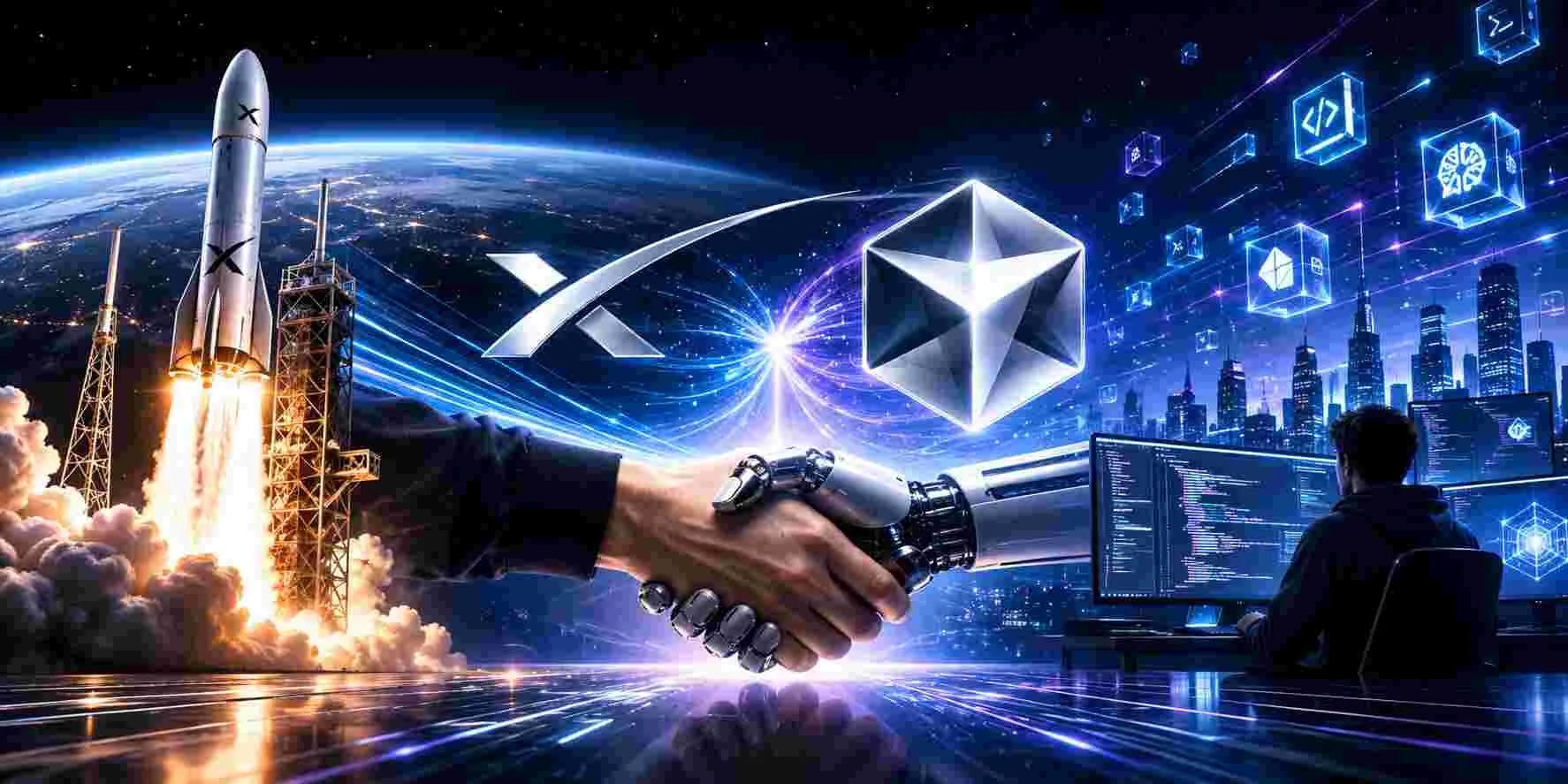
In a move that sent shockwaves through Silicon Valley and Wall Street alike, SpaceX officially announced on June 16, 2026 — just four days after its record-breaking Nasdaq IPO — that it has signed a formal merger agreement to acquire Anysphere, Inc., the San Francisco-based company behind the AI coding tool Cursor, in an all-stock deal valued at a staggering $60 billion. The transaction, confirmed through an SEC Form 8-K regulatory filing, is expected to close in the third quarter of 2026, pending regulatory approvals.
This is not merely a corporate deal. It is a declaration of war in the AI coding market — and a signal that the race to dominate the future of software development has entered an entirely new, billion-dollar phase. For developers around the world, for enterprise software teams, for investors, and for anyone building with AI, the implications are profound and immediate.
The Biggest Acquisition in Developer Tooling History
To understand the magnitude of this deal, context is essential. Cursor is the most widely used AI-powered code editor among professional developers. Founded in 2022 under the Anysphere name in San Francisco, the platform has experienced one of the fastest growth trajectories in the history of enterprise software. In early 2025, Cursor's Annual Recurring Revenue (ARR) stood at approximately $100 million — already impressive for a two-year-old startup. By early 2026, that figure had surpassed $2 billion. And by June 2026, Cursor was generating roughly $2.6 billion in annualized B2B revenue, with deployment reported across 64% of Fortune 500 companies and over one million paying users.
Cursor had previously raised $2.3 billion in a Series D round in November 2025, which had pegged its valuation at $29.3 billion — already a remarkable figure. By April 2026, the startup was in advanced discussions to close a new $2 billion funding round led by Andreessen Horowitz, Nvidia, and Thrive Capital, at a valuation above $50 billion. SpaceX's $60 billion offer exceeded that figure and effectively ended the fundraising process before it could be completed.
According to CNBC, the $60 billion in SpaceX Class A common stock that the company has agreed to pay represents a 3.4% dilution at SpaceX's IPO valuation — a relatively modest price for a company now capitalized at over $2.7 trillion. At closing, each share of Cursor's common and preferred stock will be converted into SpaceX Class A shares, with the exchange ratio determined by the volume-weighted average closing price of SpaceX stock over the seven trading days immediately before the deal closes.
From Rockets to Code: How xAI Changes Everything
SpaceX's interest in AI coding tools is not accidental. In February 2026, SpaceX completed a landmark merger with xAI — Elon Musk's artificial intelligence company and creator of the Grok chatbot — folding the AI division, the X platform, and the Colossus supercomputing cluster in Memphis, Tennessee into a unified entity now operating under the banner of SpaceXAI. That merger, finalized on May 6, 2026, valued xAI at approximately $250 billion.
The acquisition of Cursor is the direct next step in this broader strategy. SpaceX's AI division has been frank about its ambitions: it wants to build, as Cursor CEO Michael Truell stated in a post on X, "the world's most useful AI models." But according to analysts, xAI and its Grok platform have struggled to establish themselves as serious competitors in the frontier AI market. As Vital Knowledge analyst Adam Crisafulli noted in an investor memo, "SpaceX hopes the Cursor team/product will give a jolt to its Grok AI business (especially in coding), which has so far failed to make a dent in the frontier market, which is led by Anthropic, OpenAI, Google, and Meta in the US, in that order."
In other words: SpaceX is buying Cursor not just for its product, but for its distribution, its enterprise relationships, and its engineering talent. Getting into the hands of more than one million paying developers — many of them embedded in Fortune 500 workflows — is something that money alone cannot buy overnight. The Cursor brand and user trust represent years of product excellence that SpaceX is now absorbing in a single transaction.
A Deal Years in the Making — But Months in the Negotiating
The relationship between SpaceX and Cursor did not materialize out of nowhere. Signs of mutual interest had been building for months. Earlier in 2026, xAI hired two of Cursor's senior engineering leaders — a move that, in retrospect, appears to have been an early step in a deeper integration strategy. By April 21, 2026, SpaceX had secured a formal option to either acquire Cursor outright for $60 billion or pay $10 billion for a collaborative arrangement. In a curious social media post on X, SpaceX confirmed it was already working with Cursor to create what it called "the world's best coding and knowledge work AI."
The option structure included significant financial incentives to complete the deal. Had SpaceX chosen not to exercise the $60 billion purchase, it would have been obligated to pay Cursor a $1.5 billion termination fee plus $8.5 billion in computing resources — a total backstop of $10 billion. That clause alone speaks to the seriousness with which both parties approached this arrangement from the start.
Meanwhile, other major players were circling. According to reports, Microsoft examined a potential acquisition of Cursor but ultimately chose not to submit a formal bid. OpenAI, for its part, made two separate approaches to Cursor's leadership — both of which were rebuffed. Cursor's founders, it seems, were intent on maintaining independence until the right partner came along. SpaceX, with its newly public status and a nearly $2 trillion market cap, apparently made an offer too compelling to refuse.
The Colossus Factor: Compute as Currency
One of the most strategically significant aspects of this deal is what it means for Cursor's model training capabilities. Cursor has long been transparent about one of its key limitations: a shortage of computing power to train its own frontier AI models. The platform currently supports multiple AI models in its editor — including Claude (Anthropic), GPT (OpenAI), and its own in-house Composer models — but training a truly competitive frontier coding model requires a scale of compute infrastructure that few companies in the world possess.
Through xAI, SpaceX controls the Colossus supercluster in Memphis, Tennessee — one of the largest GPU clusters on the planet. This is the infrastructure that Cursor will now be able to leverage for model development. According to Techzine, SpaceX confirmed that the two companies have already been jointly training a new AI model using the Colossus infrastructure, and that this model is expected to be released soon through both the Cursor platform and xAI's Grok Build product.
For comparison, in recent weeks SpaceX also signed separate compute-leasing agreements with Anthropic and Google, totaling approximately $26 billion per year combined — a figure that underscores just how aggressively the company is positioning itself as a compute provider and AI infrastructure player at the same time as it acquires AI-native software companies.
What This Means for Developers: A Moment of Uncertainty
For the estimated four million active developers currently using Cursor as their primary coding environment, the acquisition has triggered a wave of legitimate questions — and not a small amount of anxiety. The Hacker News community, one of the most discerning developer audiences in the world, erupted in debate within hours of the announcement, with threads generating hundreds of comments focused on several critical concerns.
Data Privacy
Cursor indexes users' codebases locally and transmits context to AI models for code completion and chat. Under Anysphere's ownership, this data handling was governed by Anysphere's privacy policy. Under SpaceX/xAI ownership, the terms could change. Developers working on proprietary enterprise codebases — including those across the Fortune 500 — will be watching the updated data handling policies closely before and after the deal closes.
Pricing
Cursor currently charges $20 per month for individual Pro accounts and $40 per user per month for Business accounts. With a $60 billion acquisition price to justify, analysts and developers are already factoring in the historical pattern: enterprise software tools acquired at high multiples tend to see pricing pressure move upward over time, particularly when the acquirer is a publicly traded company with shareholders to satisfy.
Model Neutrality


One of Cursor's most valued features among developers has been its model-agnostic approach — the ability to choose between Claude (Anthropic), GPT-4 (OpenAI), Gemini (Google), and Cursor's own Composer models within a single editor environment. Now that Cursor is being absorbed into the SpaceX/xAI ecosystem, there are well-founded concerns that model prioritization could shift toward Grok, potentially reducing or deprioritizing access to competing AI providers. For developers who have built workflows around specific models, this is a significant variable.
Product Velocity
Cursor's speed of iteration over the past two years has been a defining competitive advantage — one largely enabled by its status as a focused, independent startup with a flat organizational structure. Large acquisitions have a well-documented history of slowing down the product roadmaps of absorbed developer tools. Whether SpaceX can maintain the agility that made Cursor's growth possible remains an open and important question.
The Financial Winners: Founders, VCs, and a $10 Billion Stake
From a financial perspective, the deal has created extraordinary wealth for a small group of insiders. Cursor's four co-founders — Michael Truell, Aman Sanger, Sualeh Asif, and Arvid Lunnemark — are each expected to see their net worth more than double through the transaction, with Forbes estimating each founder's anticipated net worth at $2.7 billion upon closing.
Early investors stand to collect returns of historic proportions. Andreessen Horowitz, with a reported stake of approximately 10%, is looking at a position worth roughly $6 billion. Thrive Capital, holding approximately 7%, stands to collect around $4.2 billion. Notably, Thrive Capital also holds a position in SpaceX — meaning its combined stake in the combined entity is now worth more than $10 billion, according to a source familiar with the matter cited by CNBC.
The deal also represents one of the most significant VC exits in AI developer tooling history, and a landmark validation of the thesis that AI-native developer tools — built from the ground up for the age of large language models — would command premiums that traditional software multiples could not predict.
The Competitive Landscape: A New Front Opens
SpaceX's acquisition of Cursor does not exist in isolation. It is part of a broader, accelerating consolidation in the AI software market that is reshaping competitive dynamics across the industry.
In the AI coding segment specifically, the competitive field now looks like this: Microsoft GitHub Copilot (powered by OpenAI), Google's Gemini Code Assist, Anthropic's Claude for coding embedded across multiple IDEs, and now Cursor/SpaceXAI as a fully integrated platform with its own frontier model in development. The battleground is no longer just about which model is most capable — it is about which platform can own the developer's entire workflow.
Reports emerging from sources close to SpaceX suggest an even more ambitious endgame. According to reporting from Basenor, the combined SpaceX/Cursor entity is reportedly preparing to launch Origin — a new code repository platform that would position directly against GitHub. If accurate, this would signal that SpaceX's ambitions in developer tooling extend far beyond AI-assisted code completion and into the foundational infrastructure layer of how software is stored, versioned, and distributed.
That would put SpaceX in direct competition with Microsoft not just in AI models, but in the repository and DevOps infrastructure market that Microsoft has dominated since its $7.5 billion acquisition of GitHub in 2018. The competitive stakes, already extraordinarily high, could escalate further still.
The Broader Signal: IPO Currency and the AI M&A Era
Perhaps the most consequential aspect of this deal is not what it means for Cursor or SpaceX specifically, but what it signals about the new rules of mergers and acquisitions in the AI era.
SpaceX went public on June 11, 2026, raising approximately $75 billion in what became the largest initial public offering in stock market history, at a valuation of $1.77 trillion. Just four days later, it used the stock currency generated by that IPO to execute a $60 billion acquisition. This is the new M&A playbook: go public, create stock, deploy that stock as acquisition currency immediately, before the market has time to fully discount the premium.
As analysts at Fortune noted, the SpaceX/Cursor deal is the first major example of a freshly public company using its IPO currency to win an AI acquisition war — and it could redefine M&A strategy for the entire class of 2026 IPOs. For other companies considering going public this year, the lesson is clear: the IPO is not an end in itself, but a funding mechanism for the next phase of competitive expansion.
SpaceX shares rose approximately 16% on the day the Cursor acquisition was announced, pushing the company's market capitalization above $2.7 trillion and briefly overtaking Amazon ($2.66 trillion) and Microsoft in market value to become one of the most valuable companies in the United States. That market reaction — rewarding an acquirer with a share price surge rather than the traditional post-acquisition dip — underscores just how much investors believe in the strategic logic of this combination.
Regulatory Path: What Comes Next
The deal is expected to close in Q3 2026, but it must first clear regulatory review. Given the current environment of heightened antitrust scrutiny in both the United States and European Union — particularly around acquisitions by large technology companies of AI-native startups — the path to closing is not without uncertainty.
SpaceX, now one of the most valuable companies in the world, acquiring a startup with 64% Fortune 500 penetration and over one million paying developer users, will attract attention from regulators already tracking consolidation in the AI sector. The fact that Cursor previously rebuffed acquisition approaches from both Microsoft and OpenAI — companies that already face their own regulatory pressures — may actually work in SpaceX's favor, positioning this deal as a market-expanding transaction rather than a consolidation of existing dominance.
Cursor CEO Michael Truell framed the acquisition optimistically in his official statement: "We are excited to share that SpaceX has exercised their option to acquire Cursor in an all-stock transaction with the goal of building the world's most useful AI models. We look forward to working closely with the SpaceX team to advance our frontier AI capabilities and continue to work closely with our customers and partners."
For now, Cursor says it will continue operating normally, with no immediate changes to its product, pricing, or model availability. But every developer who depends on Cursor understands that the landscape has shifted, and the real question is not whether things will change — but when, and how much.
What Developers, Investors, and Enterprises Should Watch
- The new AI model release: SpaceX has confirmed a jointly trained Cursor/Grok model is coming "soon." How it performs against Claude, GPT, and Gemini will be the first real signal of whether this acquisition delivers on its technical promise.
- Origin, the GitHub rival: If reports of a new code repository platform are accurate, this acquisition is the opening move in a much larger battle for developer infrastructure dominance.
- Model availability changes: Watch whether SpaceX begins to limit or deprioritize Claude and GPT access within Cursor's interface — a move that would force developers to rely on Grok and could trigger a migration away from the platform.
- Regulatory approval timeline: Any delays or conditions imposed by the DOJ or EU competition authorities could affect the deal's closing and the pace of integration.
- Pricing updates: Enterprise customers should review their contracts and scenario-plan for potential pricing changes as SpaceX's investor obligations mature.