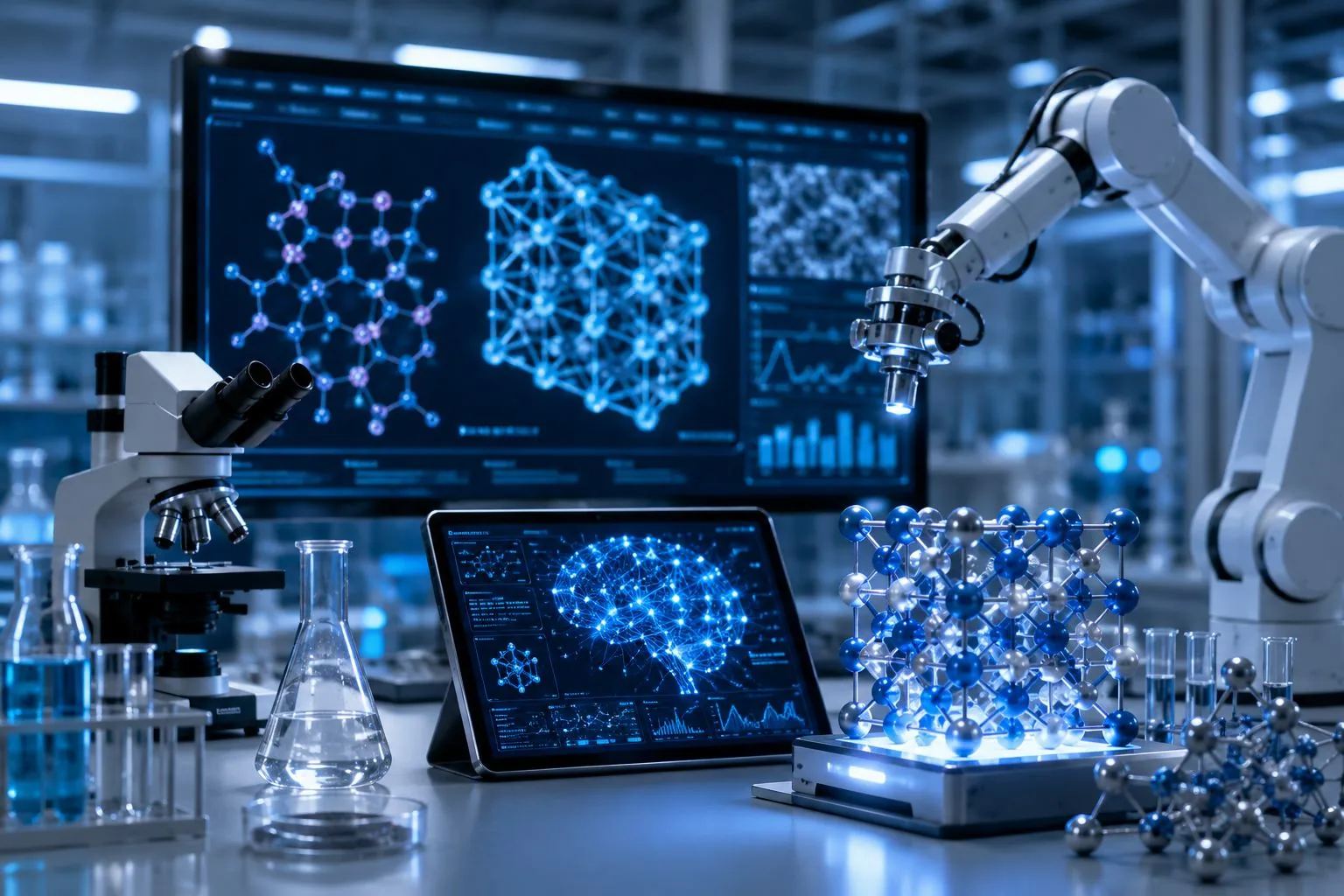
Artificial intelligence is revolutionizing materials science by enabling researchers to identify promising chemical compounds at speeds unimaginable with traditional methods. Across research centers in the United States, Europe, China, Japan and beyond, scientists now rely on advanced algorithms to accelerate the discovery of substances that could transform clean energy, batteries, electric vehicles, computing and medicine. This approach marks a profound shift in the way science is conducted, replacing slow, expensive manual experimentation with data-driven prediction. The result is an unprecedented acceleration in the search for materials that underpin critical technologies.
The End of Costly Trial-and-Error Research
Historically, discovering a single new material often required decades of labor-intensive work. Scientists would formulate hypotheses, synthesize compounds, and conduct countless laboratory tests before finding promising results. The financial burden was equally heavy, demanding specialized equipment and skilled teams. With machine learning, this landscape is shifting dramatically. Systems now analyze vast scientific databases from universities and corporations, identifying patterns that would be impossible to detect manually. This allows researchers to predict, before any physical experiment, which chemical combinations are most likely to exhibit specific properties. Experimental validation remains essential, but the process has become significantly faster.
Patterns Invisible to the Human Eye
Modern artificial intelligence systems are trained on enormous collections of scientific data from universities and companies. From this information, the models detect subtle correlations and patterns that human researchers would miss. This predictive power dramatically reduces the number of physical experiments required, increasing the odds of finding innovative materials. In recent projects, AI systems identified promising candidates for industrial applications that could have taken decades to discover using conventional approaches. The impact is already being felt in areas such as batteries, renewable energy, and semiconductors.
More Efficient and Sustainable Batteries
Battery development stands out as one of the fields most transformed by this technology. The rise of electric vehicles and the growing need for renewable energy storage have intensified the demand for systems that are more efficient, safer, and more sustainable. Researchers deploy AI to pinpoint materials that increase energy density, shorten charging times, and extend battery lifespan. The discovery of new compounds could accelerate the global transition toward a clean-energy economy. Supercomputers operating at exascale speeds — performing trillions of calculations per second — make much of this work possible. When combined with AI models, these machines enable detailed simulations of molecules and atomic structures, opening up scientific scenarios previously inaccessible. Governments around the world are investing billions of dollars in expanding this computational infrastructure.
Universities, Industry, and the Race for Discovery
Universities continue to play a central role, collaborating closely with technology companies and government laboratories. Many of the current algorithms originated from academic projects in materials science, computational physics, and machine learning. Cloud-computing giants and digital-infrastructure firms have also entered the race, recognizing substantial economic potential. The result is an increasingly integrated ecosystem where science, technology, and industry converge. Despite the progress, challenges persist: not every AI prediction is confirmed experimentally, and the quality of training data remains critical. Global competition is intensifying, with nations such as the United States, China, the European Union, Japan, and South Korea making heavy investments.
The Broader Economic and Scientific Stakes
The potential economic impacts are enormous, ranging from reduced production costs to the creation of entirely new markets. As countries compete to lead in this field, the race to develop new materials will define strategic sectors such as energy, electronics, and medicine. The future points toward ever greater integration between algorithms and scientific research, accelerating innovation for some of the century's biggest technological and environmental challenges. However, the tension between rapid AI-driven predictions and the necessity of rigorous experimental validation remains a fundamental issue. The scientific community must ensure that the speed of discovery does not come at the expense of reliability.
Governments and corporations face a critical balancing act: how to allocate investments between colossal computational infrastructure and the maintenance of physical laboratories. The laboratory of the future is likely to be hybrid — combining digital simulations with hands-on experiments. This new paradigm redefines the very concept of research, making it a seamless blend of computation and empirical science. Readers should watch how these investments unfold, as they will shape the pace and direction of materials innovation in the coming years.