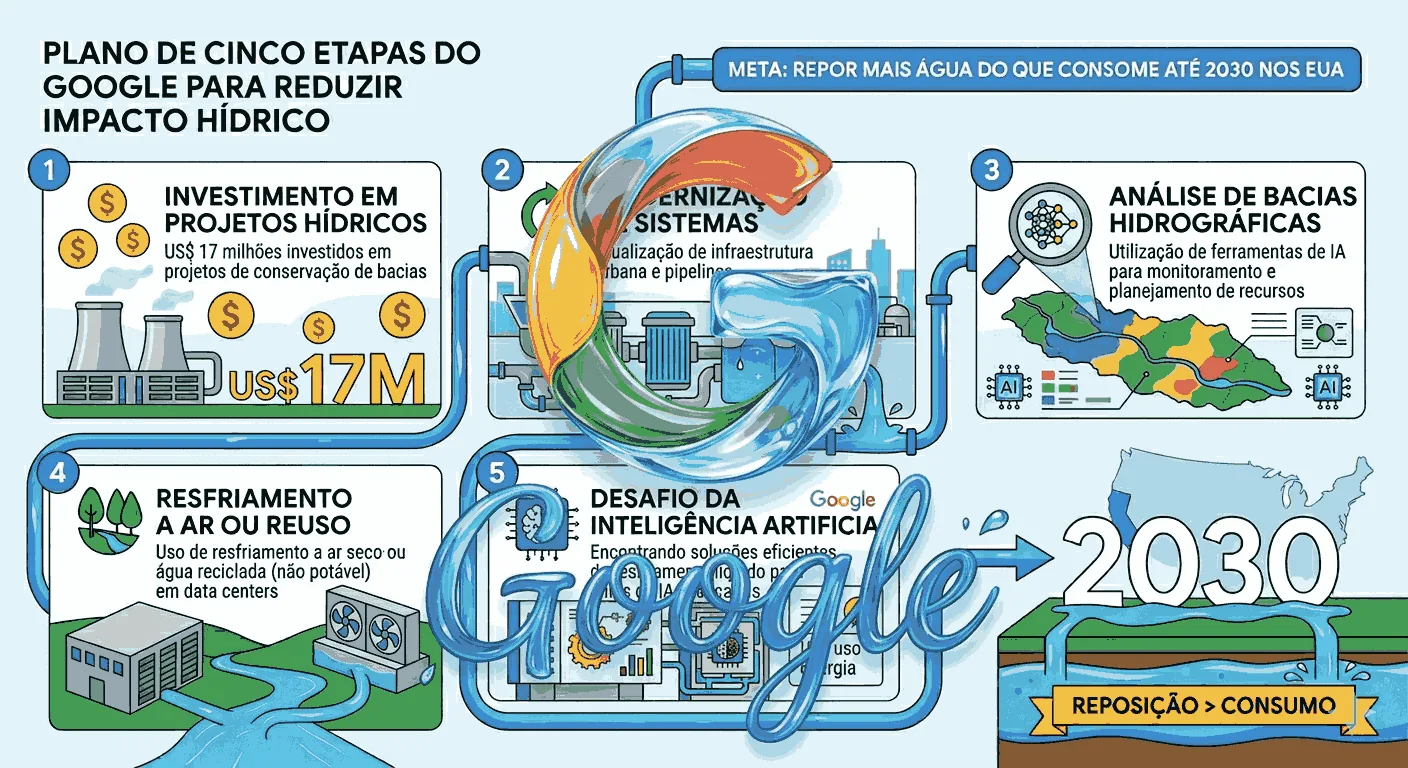
Google has announced a comprehensive five-step plan to replenish more water than its data centers consume in the United States by 2030, directly targeting the environmental footprint of its expanding artificial intelligence infrastructure. The announcement, made on Wednesday, outlines a series of measures including a $17 million investment in water management projects and upgrades to cooling systems. This initiative arrives amid growing public and regulatory scrutiny over the resource consumption of major technology companies. The company aims to not only offset but exceed the water used for cooling its U.S. data centers within the next four years.
A Five-Stage Roadmap to Water Positivity
The centerpiece of the plan is the commitment to achieve "water positive" status by 2030, meaning the volume of water returned to the environment will surpass what is withdrawn for cooling. To reach this goal, Google will expand its portfolio of water stewardship projects in the regions surrounding its data centers and adjacent watersheds. The $17 million investment—approximately 86.1 million Brazilian reais at current exchange rates—will fund a range of initiatives. These include reinforcing local water supplies, detecting leaks in distribution networks, and supporting community water infrastructure. The company stated that this funding will be allocated to both new and existing projects aimed at improving water availability and quality.
Modernizing Municipal Water Systems
Another critical component involves assisting cities that host Google data centers in upgrading their water supply and treatment systems. The company will help modernize local hydraulic infrastructure and implement technologies to identify water losses in the pipeline network. Additionally, Google commits to conducting detailed watershed analyses before constructing any new data center. If the proposed water usage poses a risk to the environment or community supply, the company will switch to air-cooling systems or utilize recycled water for cooling. This preemptive evaluation is designed to prevent conflicts over water resources from the outset.
The Surge in Water Demand Driven by Artificial Intelligence
Operating a data center requires immense energy to run servers and cooling systems around the clock. The training of sophisticated artificial intelligence models demands vast amounts of data processed by modern chips that generate significant heat. To maintain optimal temperatures, liquid cooling—using water or oil—is often necessary, unlike traditional cloud data centers that can rely on air cooling. A study from the University of California, Riverside, illustrates the scale: asking 50 questions to ChatGPT consumes approximately half a liter of water. This figure underscores the hidden environmental cost of AI services.
Limited Scope and Emerging Markets
The current plan explicitly targets only the United States, leaving open questions about Google's water commitments in other nations. In Brazil, for example, there are approximately 180 data centers in operation, though none are dedicated to artificial intelligence. However, four AI-focused data center projects have been announced for the country, each with energy demands equivalent to 16.4 million households. The expansion of AI in such markets could further strain water resources, especially if these facilities adopt liquid cooling without compensatory measures. Google's silence on international targets raises concerns about the uniformity of its environmental standards.
A Modest Investment Facing Enormous Challenges
The $17 million investment, while notable, represents a relatively small sum for a company of Google's size. Critics may argue that the initiative is more strategic than transformative, aimed at preempting stricter regulations and public backlash. The success of the 2030 goal will depend on Google's ability to scale water restoration projects and adapt its infrastructure globally. Without binding commitments for other regions, the plan risks being seen as a partial solution to a worldwide problem. Transparency in reporting the outcomes of these projects will be crucial for building trust with stakeholders.
Google's announcement reflects mounting pressure on the technology sector to address the environmental consequences of the artificial intelligence boom. By pledging to return more water than it uses, the company aims to get ahead of potential criticism and avoid stricter future regulations. However, the 2030 deadline applies only to its American operations, and details about implementation in other countries remain undisclosed. The plan's ultimate success hinges on the company's capacity to scale its water projects and adjust its global infrastructure accordingly. Observers will be watching closely to see whether this initiative serves as a template for other tech giants or remains an isolated effort.