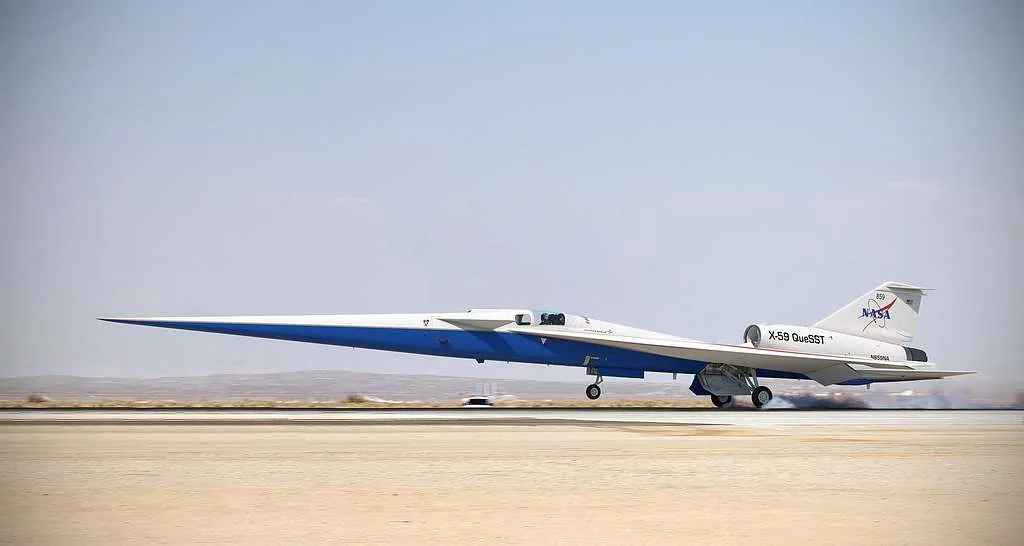
The Premise News — NASA's experimental X-59 aircraft shattered the sound barrier for the first time on June 5, 2026, achieving a historic milestone in the agency's Quesst mission aimed at developing quiet supersonic flight technology. The breakthrough took place at Edwards Air Force Base in California during an 81-minute flight piloted by Jim “Clue” Less, who guided the aircraft to Mach 1.077 at an altitude of 43,400 feet. This event marks the beginning of a campaign that could fundamentally reshape commercial aviation by enabling overland supersonic travel without the disruptive sonic boom. The flight represents the culmination of years of aerodynamic research and signals a new chapter in aerospace innovation.
Milestone Flight Details and Immediate Program Goals
The June 5 sortie was not the X-59's maiden voyage—that occurred on October 28, 2025—but it was the first time the aircraft exceeded Mach 1, reaching approximately Mach 1.1. The maximum speed recorded was 713 mph (1,147 km/h) at 13,228 meters altitude. Michael Kratsios, the White House science and technology adviser, hailed the achievement as evidence of American leadership in aerospace innovation. The Quesst team is already planning the next flight, which aims to reach Mach 1.4 and 55,000 feet, accelerating the pace of data collection.
Acoustic Data Collection Strategy Over Communities
The Quesst mission's core objective is to replace the traditional sonic boom with a softer sound NASA calls a “thump.” To validate this, the X-59 will fly over multiple U.S. communities, measuring human perception of the noise generated. The resulting data will be shared with regulators in the United States and internationally, with the hope of establishing new noise standards based on real-world evidence. This work is crucial because the Federal Aviation Administration has banned supersonic flights over land since 1973, citing the disruptive impact of sonic booms.
Accelerated Testing and Aerodynamic Innovation
The X-59, built by Lockheed Martin Skunk Works, has undergone a rigorous testing regimen, completing 16 flights in the 90 days leading up to June 5. Jared Isaacman, NASA administrator, thanked the teams involved and expressed hope that this collaboration would continue across the agency's experimental aircraft portfolio. The aircraft's elongated nose design is specifically engineered to minimize shockwave formation, reducing acoustic impact compared to previous supersonic aircraft. This innovative shape is not merely cosmetic but the product of decades of supersonic aerodynamics research.
The Pilot's Role and Next Steps
Pilot Jim “Clue” Less, a veteran NASA test pilot, commanded the historic flight, and the aircraft's external vision system recorded the exact moment it reached Mach 1.077. NASA has not released details on the pilot's in-cockpit perception during supersonic transition, but flight data will be used to calibrate subsequent tests. The agency plans to begin the community overflight campaign soon after completing this operational testing phase. The success of these flights will determine whether the “thump” is acceptable to residents below.
The advances of the X-59 come against a backdrop of five decades of restrictions on overland supersonic flight. Since the FAA prohibition in 1973, no civil aircraft has legally operated above Mach 1 over inhabited areas. If NASA can demonstrate with concrete data that the X-59's thump is tolerable, regulators may reconsider the ban. This would revolutionize air travel, drastically cutting flight times. For now, the priority is gathering robust and reliable acoustic data.