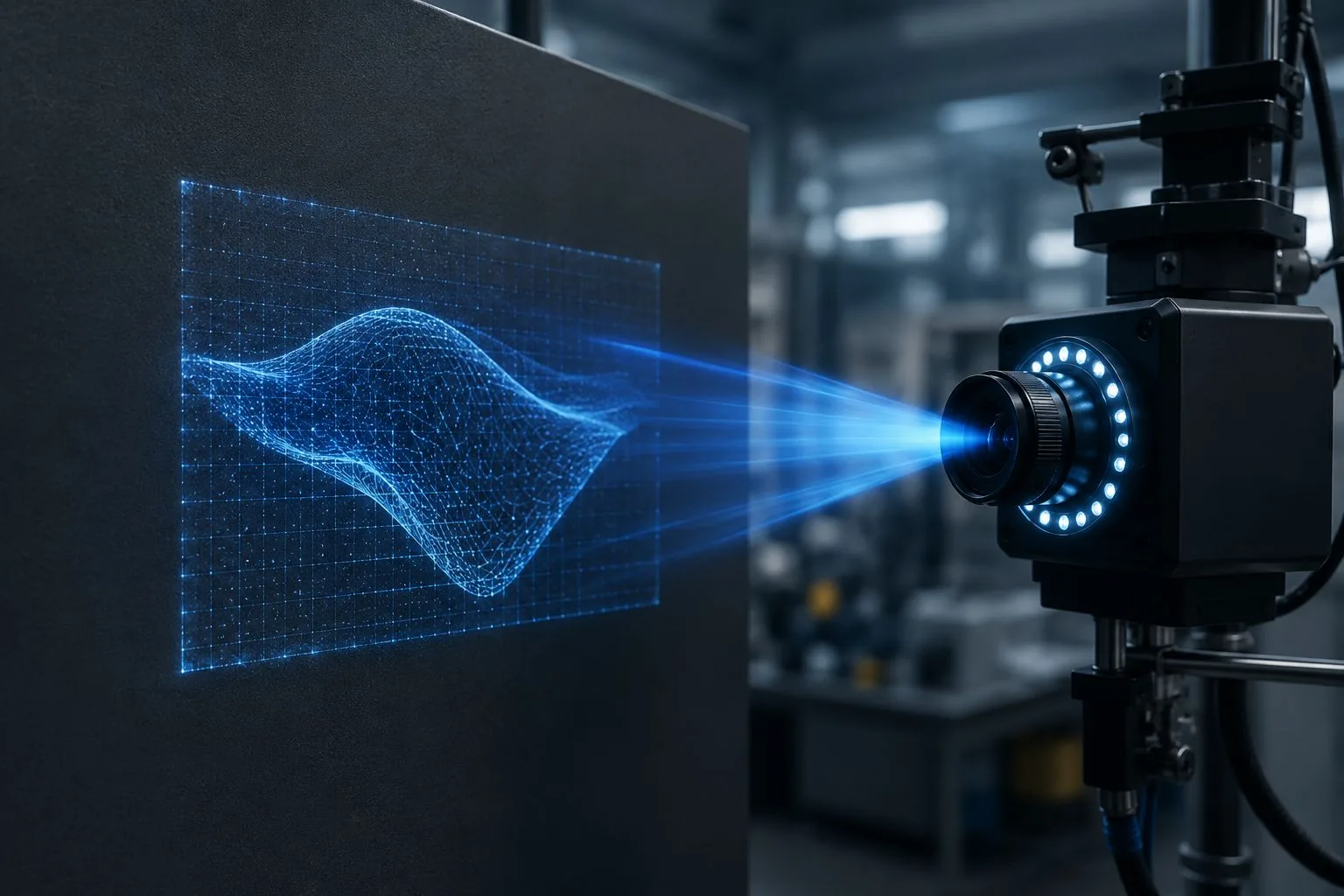
A new computational imaging method developed by researchers at Rice University and the University of Arizona transforms everyday matte surfaces—such as walls, furniture, and clothing—into virtual display screens, allowing machines to reconstruct three-dimensional scenes with exceptional speed and precision. Published in Nature Communications, the technique addresses a critical weakness in current machine vision: the inability to accurately capture dynamic environments containing both matte and reflective objects. By projecting laser light onto nonreflective surfaces and using a high-speed neuromorphic event camera, the system can record rapid changes in light intensity rather than full frames, dramatically improving performance under challenging lighting conditions and with moving subjects. This breakthrough could significantly advance applications from autonomous driving and industrial inspection to facial recognition and human sensing.
Innovative Approach Tackles Long-Standing Challenge in Machine Vision
Most existing 3D imaging systems rely on structured light, which projects patterns onto a scene and measures how those patterns deform across object surfaces to create depth maps. While widely used, these systems often falter when faced with motion, harsh lighting, or scenes that contain a mix of matte and reflective materials. In such mixed-reflectance environments, light bouncing between surfaces distorts measurements and degrades image quality. The new method overcomes these obstacles by repurposing the very surfaces that cause trouble—matte walls, clothing, and furniture—into virtual screens that reflect projected laser points onto shiny objects.
Deflectometry Reimagined
Ashok Veeraraghavan, chair of the Department of Electrical and Computer Engineering at Rice’s George R. Brown School of Engineering and Computing, explained that the team leveraged a well-known technique in computer vision called deflectometry, which measures the shape of shiny surfaces by observing how projected light patterns distort upon reflection. Traditionally, deflectometry requires large, carefully positioned screens, making the process expensive and inflexible. By projecting laser light onto matte surfaces already present in a scene, the researchers eliminated the need for specialized equipment, turning any room into a functional imaging environment.
How the System Works: Lasers and Neuromorphic Sensing
The imaging process unfolds in two steps. First, a laser scans matte surfaces such as walls, clothing, and furniture to create precise 3D maps of those surfaces. When laser points reflect off shiny objects, the system effectively repurposes the surrounding matte surfaces into virtual display screens, as described by Aniket Dashpute, a graduate student in Veeraraghavan’s lab and the study’s first author. Second, a neuromorphic event camera—which records changes in light intensity rather than capturing full image frames—reconstructs high-speed 3D videos. This camera can handle vastly different light levels, from very dim to extremely bright, allowing all object surfaces in a scene to be measured with equally high accuracy and speed, regardless of variations in reflectivity, noted Jiazhang Wang, a postdoctoral research associate at the University of Arizona’s Wyant College of Optical Sciences and the paper’s second author.
The combination of laser scanning and event-based imaging represents a significant departure from conventional 3D sensing. Where standard cameras would be overwhelmed by rapid motion or extreme lighting contrasts, the event camera captures only changes, reducing data load and increasing temporal resolution. This makes the system particularly suited for real-time applications where every millisecond counts.
Potential Applications Across Industries
The advance could transform machine vision in several high-stakes fields. For autonomous vehicles, the ability to accurately perceive pedestrians, other cars, and road surfaces in mixed lighting and complex reflective conditions is critical for safe navigation. In industrial inspection, manufacturers could use the technique to detect defects on shiny metal parts or transparent surfaces that currently elude standard scanners. Facial recognition systems could benefit from more robust depth sensing in varied environments, while human sensing applications—such as gesture recognition or health monitoring—could gain from the method’s speed and accuracy.
Scalability From Microscopic to Architectural Scales
Although the technology has so far been demonstrated only in a tabletop laboratory setting, the researchers emphasize that the approach is inherently scalable. As Florian Willomitzer, associate professor at the Wyant College of Optical Sciences and collaborator on the study, explained, scalability is a crucial requirement for 3D imaging. The same method could be adapted to measure tiny reflective blood vessels during surgery or to digitize entire rooms and buildings, offering the flexibility to operate at very different scales and environments. This versatility suggests that the technique could eventually be miniaturized for handheld devices or expanded for large-scale architectural scanning.