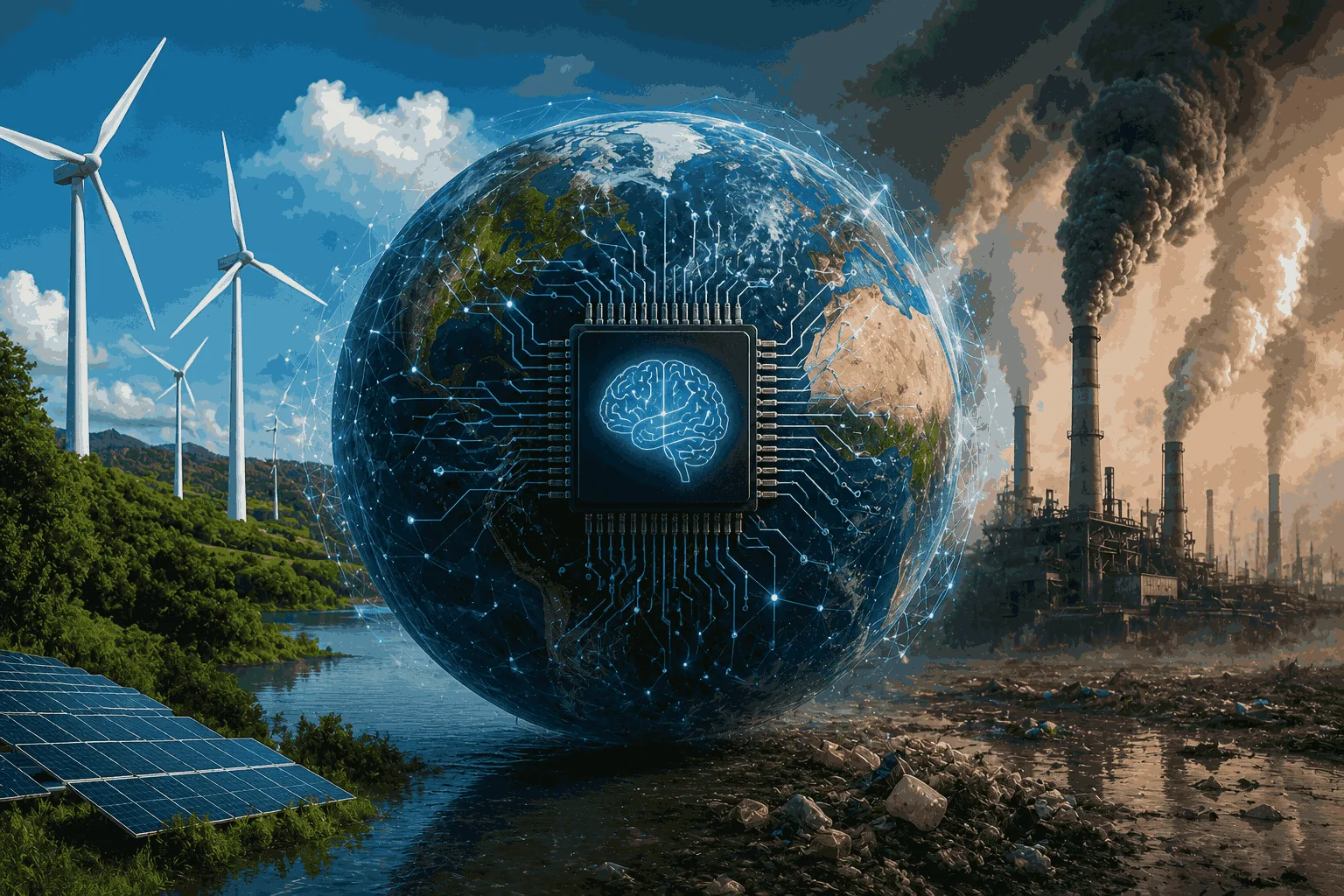
A newly released United Nations report warns that the global energy consumption of artificial intelligence is on track to double by 2030, reaching roughly 3% of all electricity generated worldwide. The document, published on June 7, 2026, by the UN, projects that resulting carbon emissions would be comparable to those of the United Kingdom. Additionally, the water required to cool AI systems would surpass the annual potable water consumption of the entire global population. The study examines environmental costs across energy, carbon, water and land use, painting a stark picture of AI's growing footprint.
The Jevons Paradox at Work
The report leans on a 19th-century economic theory known as the Jevons paradox, formulated by William Stanley Jevons. The concept holds that efficiency gains in resource use do not necessarily reduce overall consumption — instead, they often spur greater demand. Jevons observed this in Victorian England, where improvements in coal efficiency led to increased coal use, not less. Applied to artificial intelligence, the paradox suggests that more efficient models could actually accelerate adoption across industries, offsetting any technical gains and potentially raising total resource demand. The authors stress that this dynamic is a core challenge for sustainable AI development.
When Efficiency Spurs Greater Consumption
Lower operational costs and improved accessibility drive AI integration into more processes and services, the report notes. This dynamic is already visible: in 2025, data centers consumed an amount of electricity equivalent to that used by Saudi Arabia, one of the world's largest energy consumers. If AI energy use doubles by the decade's end, the study estimates that approximately 6.7 billion trees planted over ten years would be needed just to offset the emissions. The scenario reinforces the argument that technical efficiency alone cannot solve the environmental problem. The report warns that this dynamic is already underway and could intensify without intervention.
Water, Land, and Geographic Concentration
Beyond energy, the infrastructure to support AI expansion would require about 9.3 trillion liters of water and a physical footprint nearly ten times the size of Mexico City. The report also highlights a stark geographic concentration: only 32 countries host cloud computing systems dedicated to AI, with roughly 90% of that capacity located in the United States and China. According to the authors, this disparity risks deepening the global digital divide, leaving many nations as mere consumers of AI while bearing the environmental costs of mineral extraction and electronic waste disposal. The document underscores that the environmental burden is unevenly distributed, with developing nations often absorbing the externalities.
Diverse Impacts by Task and Model
The document stresses that AI's environmental impact varies significantly based on usage frequency and the type of application. Tasks such as text generation, coding, image creation and video production demand different levels of computational power, directly influencing energy and resource consumption. The choice of AI model also matters, as different systems carry distinct environmental costs for similar tasks. Against this backdrop, the UN proposes a set of principles to guide sustainable AI development: transparency, efficiency by design, responsibility throughout the lifecycle, equity, international cooperation and sustainable use of natural resources. The authors argue that these principles must be embedded from the outset to avoid runaway resource consumption.
Recommendations and Regulatory Gaps
Among the report's recommendations is the adoption of regular environmental reporting during the development and operation of AI systems. It also urges governments to incorporate AI demand projections into their energy and climate planning. This concern becomes more pressing as AI becomes embedded in public services. Countries such as New Zealand and Australia have already launched national strategies to expand AI use in government — New Zealand has created a framework for public-sector adoption, while Australia is working on automated transcription of audiovisual archives and support for processing government requests. Both nations are moving ahead with AI integration, but the report warns that their regulatory approach may be insufficient.
However, the report observes that both countries employ light regulatory models focused on general principles. The authors argue that such an approach may sideline the environmental impacts of AI expansion. The document advocates for an analysis covering the entire AI production chain, from raw material extraction to equipment recycling and disposal. Without this systemic view, efficiency gains may be nullified by the rapid growth of AI usage. The study calls for a holistic framework that accounts for lifecycle costs and prevents the paradox of efficiency from undermining sustainability goals.