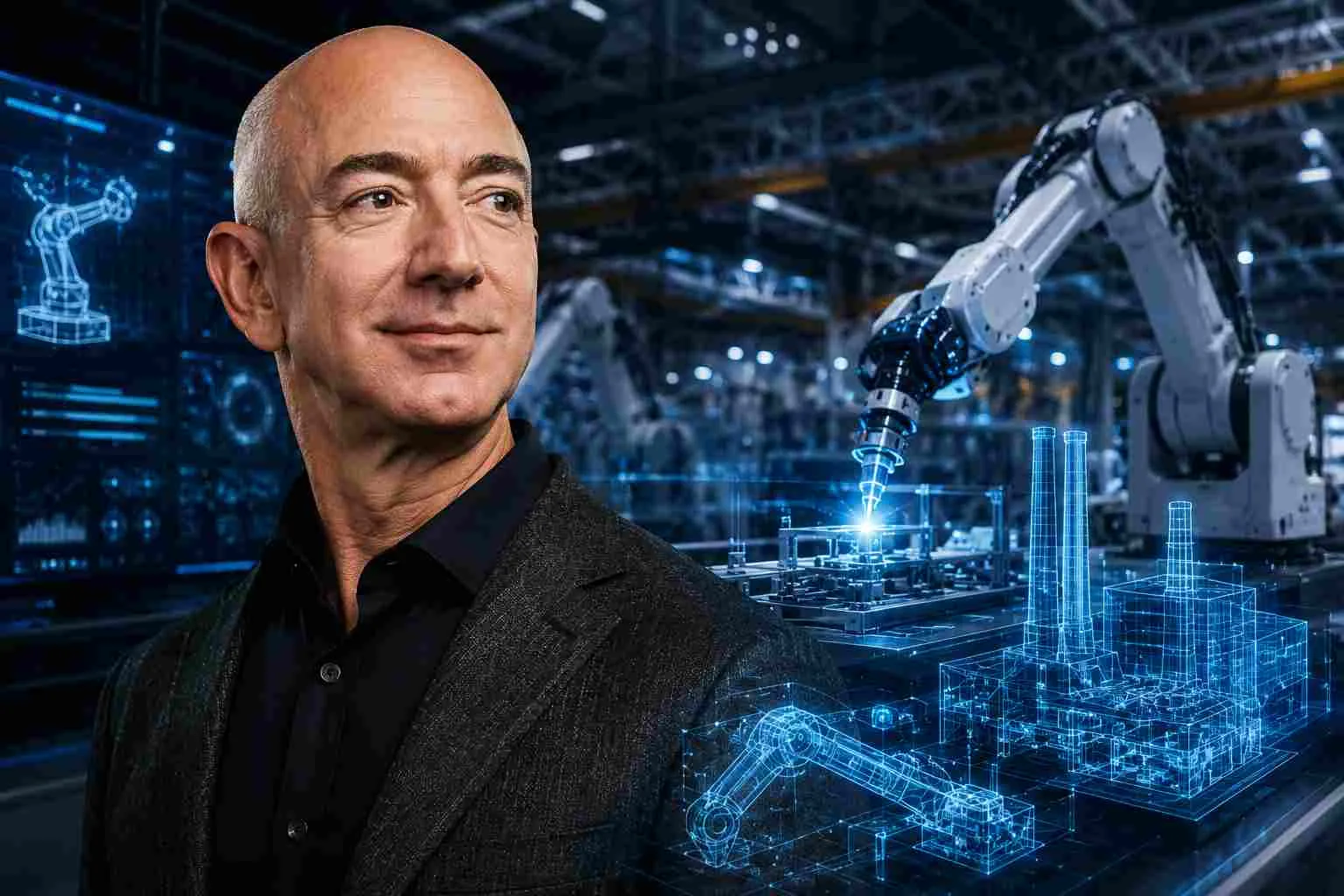
Jeff Bezos is spearheading an ambitious initiative that could fundamentally alter the future of global manufacturing through Prometheus, an advanced artificial intelligence platform dedicated to engineering, industrial design, and production process automation. The project captured international attention after Prometheus completed a funding round of approximately US$12 billion, pushing its market valuation to around US$41 billion. Financial market sources disclosed that Bezos and his partners are exploring the creation of an investment fund that could reach US$100 billion to acquire and modernize industrial companies using artificial intelligence. This initiative arrives at a time when governments, investors, and technology giants are jostling for position in a sector seen as critical to global economic growth over the coming decades.
The Prometheus platform and its massive funding appeal
Prometheus is an artificial intelligence startup established with the goal of developing sophisticated systems that can assist engineers, designers, and industrial firms in creating complex products and optimizing production processes. Unlike platforms focused on chatbots or content generation, the company concentrates its efforts on applying AI to real-world physical challenges, including advanced manufacturing, semiconductors, aerospace, energy, and infrastructure. The company has drawn attention because of its rapid growth and the backing of some of the largest investors in the technology sector.
What is the Artificial General Engineer and how does it work?
The primary objective of Prometheus is to develop what it calls the Artificial General Engineer (AGE), an artificial intelligence system designed to collaborate with engineering professionals on extremely complex tasks. In practice, the technology could help teams design engines, aircraft, factories, chips, industrial equipment, and other advanced structures. The concept goes beyond traditional AI models currently in use because it seeks to operate directly within engineering and industrial innovation processes. Experts believe that a tool of this kind could significantly reduce the time needed for research, development, and testing of new products. The system is expected to analyze vast amounts of technical data, interpret project requirements, suggest engineering solutions, and identify potential improvements even before the physical construction of prototypes begins.
Why is Jeff Bezos betting on the next industrial revolution?
After transforming e-commerce with Amazon and advancing space exploration through Blue Origin, Jeff Bezos is now turning his attention to artificial intelligence applied to industry. The vision behind the project is straightforward: use AI to dramatically boost industrial productivity and accelerate technological innovation on a global scale. According to market analysts, Bezos believes that the next big economic revolution will not happen only in digital services but primarily in factories, engineering centers, and supply chains. This strategy differentiates Prometheus from many AI companies focused solely on software applications.
The proposed $100 billion fund and strategic sectors
One of the most striking pieces of news in recent months has been reports that Bezos is seeking to raise up to US$100 billion to invest in industrial companies. However, it is important to note that the fund has not been officially created yet. What is confirmed is that discussions are underway with investors and financial institutions about the possibility of raising capital for a large-scale initiative aimed at industrial transformation through artificial intelligence. If realized, the project could become one of the largest technology investment funds in history.
Which strategic sectors are in focus for the initiative?
The funds raised could be directed toward areas deemed fundamental for the global economy and for the national security of various countries. Among the sectors identified as priorities are:
- Semiconductors and chip manufacturing;
- Aerospace industry;
- Defense and security;
- Energy;
- Industrial infrastructure;
- Advanced manufacturing;
- Robotics and automation.
These segments involve highly complex processes that can significantly benefit from artificial intelligence. Semiconductor production, in particular, has become a strategic issue for governments and companies worldwide. Modern chips are essential for smartphones, computers, electric vehicles, military systems, and AI platforms. In recent years, disruptions in the global supply chain have demonstrated the importance of this sector for the world economy.
How will industrial AI impact the labor market?
The large-scale adoption of artificial intelligence also raises discussions about the future of work. While certain activities may become automated, experts emphasize that new opportunities should emerge in areas related to technology, data science, engineering, and supervision of intelligent systems. The challenge will be to prepare workers for an increasingly digital and automated environment. Governments, universities, and companies will need to play an important role in the professional training required for this transition.
Global competition and a trillion-dollar market
The project led by Jeff Bezos arises amid intense international competition. Companies in the United States, Europe, and Asia are investing billions of dollars in artificial intelligence development, computational infrastructure, and new technology platforms. The race involves not only economic matters but also geopolitical interests related to innovation, defense, and technological sovereignty. Experts believe that the combination of artificial intelligence and industry will be one of the largest markets of the coming decade, with a potential economic impact in the trillions of dollars in additional productivity. Industry reports indicate that this potential helps explain the growing investor interest in projects like Prometheus.
What to expect in the coming years from Prometheus?
Prometheus is still in the early stages of developing its most ambitious vision, but market interest demonstrates that there is strong demand for solutions capable of revolutionizing global industry. If the company manages to achieve its goals, artificial intelligence could assume a central role in product creation, new technology development, and modernization of supply chains. The possible creation of a billion-dollar fund would further expand the reach of this transformation, enabling large-scale investments in strategic sectors of the world economy. Although many technical and financial challenges still need to be overcome, the project led by Jeff Bezos is already seen as one of the most important initiatives of the new era of artificial intelligence applied to industry.