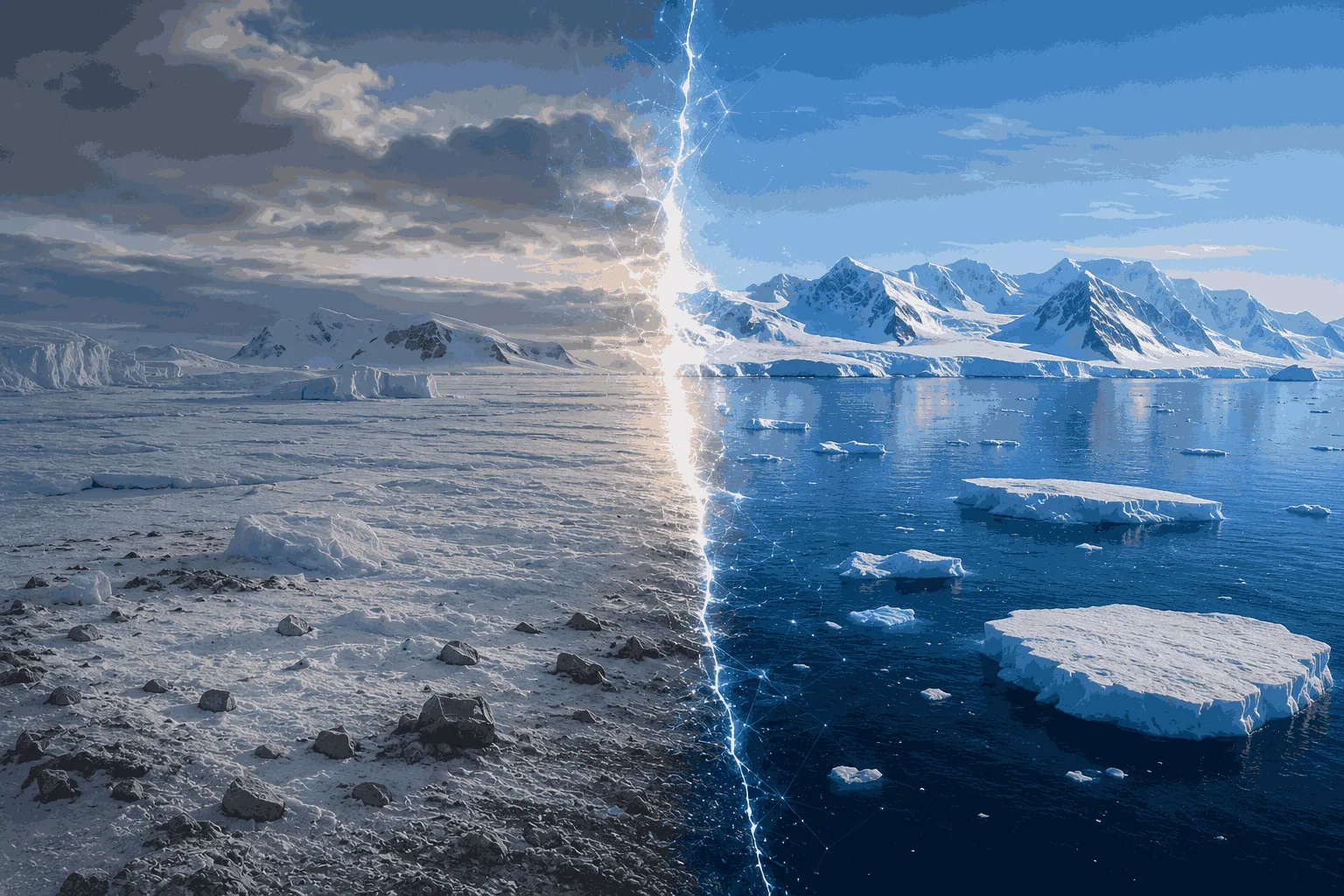
Antarctic ice sheet crossed a critical tipping point roughly one million years ago, fundamentally altering its sensitivity to climatic shifts, according to a study published in Nature Geoscience. The research reveals that after atmospheric carbon dioxide levels fell below approximately 240 parts per million, the ice sheet's response to environmental changes became far more pronounced and abrupt. This previously undocumented transformation carries direct implications for current sea-level rise projections, which remain among the most uncertain aspects of climate models. Scientists reconstructed Earth's climatic evolution over the past three million years, pinpointing the moment the polar cap lost its relative stability.
A Journey into Antarctica’s Ancient Past
The investigation zeroed in on the Mid-Pleistocene Transition, a period spanning roughly 1.2 million to 700,000 years ago. Before this transition, glacial and interglacial cycles occurred every 41,000 years in a relatively predictable rhythm. Afterward, those cycles lengthened to about 100,000 years, characterized by longer and more intense cold phases. Although scientists already knew this shift took place, detailed evidence of how the ice sheets responded during the process remained scarce, primarily due to the lack of ancient climate records.
The Role of CO₂ in the Transformation
To fill that gap, a research team led by Kyung-Sook Yun of the Center for Climate Physics at Pusan National University in South Korea employed high-resolution computer simulations. The researchers fed temperature and precipitation data into a specialized ice-sheet model capable of tracking processes such as ice flow, thickness, internal heating, and interactions with the ocean. Running the simulation required one of the country’s most advanced scientific supercomputers. In this way, the team detected a tipping point that had gone unnoticed: when atmospheric CO₂ dropped below roughly 240 ppm, the ice cap’s response pattern changed radically.
Three Factors That Sealed the Change
According to the study’s authors, the transformation was not gradual but relatively sudden. Once the CO₂ threshold was crossed, the ice began reacting in an amplified way to environmental triggers, marking a fundamental shift in the system’s behavior. The researchers identified three key contributors to this pivot. First, ocean cooling during glacial periods reduced melting at the base of the glaciers. Second, the global sea-level drop relieved pressure on the Earth’s crust, allowing the rocky bed beneath Antarctica to slowly rise. That uplift, combined with colder waters, promoted ice accumulation along coastal areas and led to the formation of thicker, more stable layers.
Together, these factors created a new climatic state in which the ice sheet became simultaneously more resilient and more sensitive to environmental variations. The scientists noted that this combination was crucial for triggering the tipping point. The finding, published on EurekAlert, reinforces the notion that large ice masses can respond nonlinearly to external forces.
Lessons for the Present and Future
Although the events analyzed occurred roughly a million years ago, the study’s conclusions are directly relevant to the modern era. They strengthen evidence for the existence of climate tipping points—thresholds beyond which a system can change abruptly and irreversibly. If the Antarctic ice sheet could dramatically alter its sensitivity in response to cooling, it may also undergo sudden shifts under global warming. Coauthor Axel Timmermann warned that Antarctic ice might react more intensely to external forces than previously believed, suggesting that some projections may fail to capture rapid transformations in the system.
Implications for Sea-Level Projections
Antarctica is considered one of the largest sources of uncertainty in estimates of ocean rise for this century. Understanding the ice sheet’s response mechanisms is therefore essential for improving climate models. The study’s main contribution is to provide evidence that the ice has already crossed a critical threshold in the past. With the identification of this tipping point, scientists gain a new tool to refine predictions about the fate of coastal regions in a warming world.