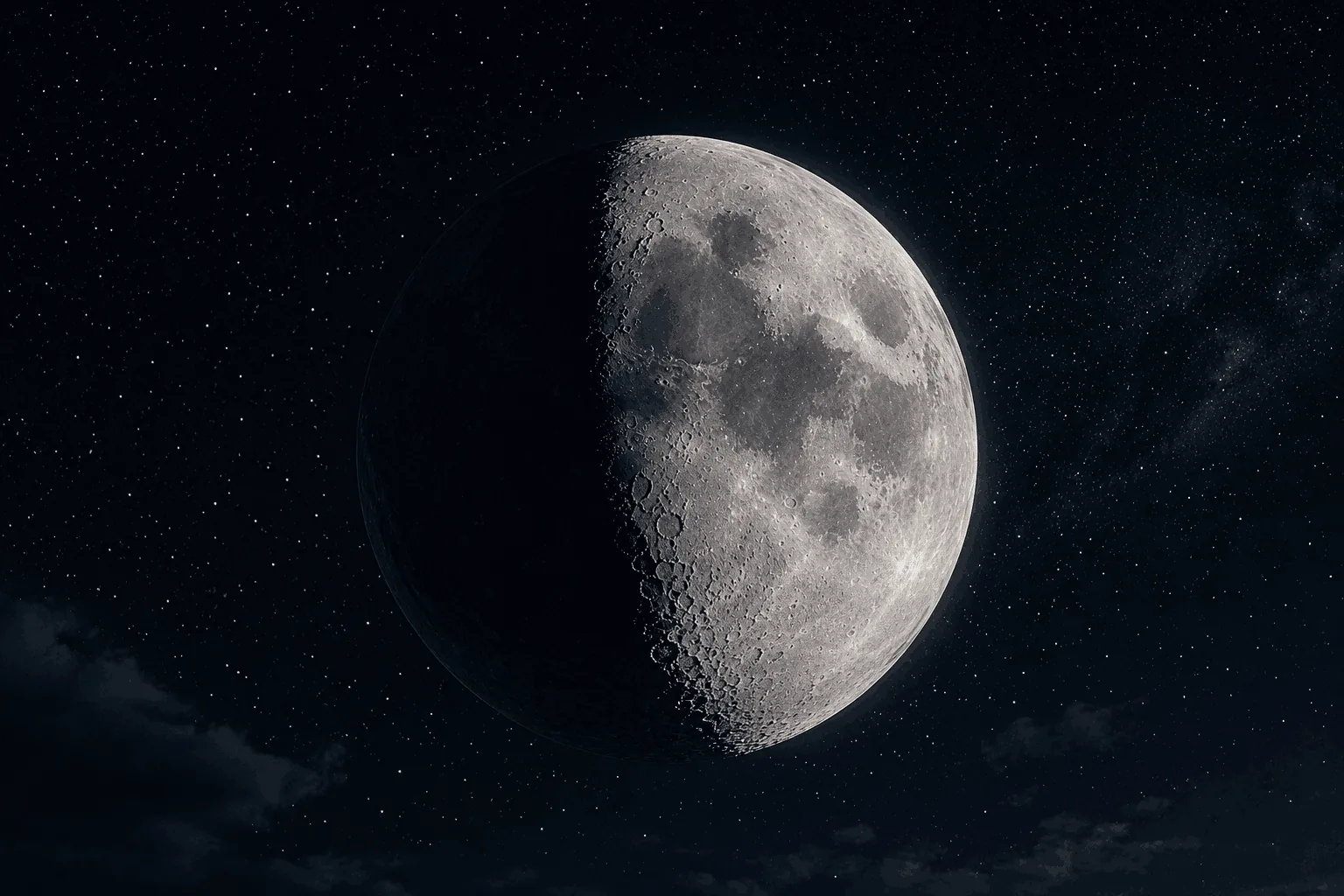
The waning moon phase on June 8, 2026, offers skywatchers a 53% illuminated lunar disk as the satellite continues its gradual descent toward darkness. According to data released by the Instituto Nacional de Meteorologia (Inmet), Brazil’s official astronomical monitoring agency, the moon currently shows just over half its surface lit, with the illuminated fraction steadily decreasing. Astronomers calculate that exactly six days remain until the New Moon arrives on June 14. This timing makes the current phase a prime window for observing lunar surface details through binoculars or small telescopes, as the boundary between light and shadow becomes especially sharp.
Full Lunar Calendar for June 2026
The month of June 2026 features a complete sequence of all four primary lunar phases, beginning with the waning phase already underway. Inmet records show that the transition into the waning phase occurred precisely at 07:03 on June 8. The next major milestone is the New Moon on June 14 at 23:56, marking the start of a fresh lunar cycle. Following that, the Crescent Moon emerges on June 21 at 18:55, and the Full Moon concludes the month on June 29 at 20:58. Each of these events represents a specific point in the moon’s approximately 29.5-day orbit around Earth, offering predictable markers for anyone tracking celestial rhythms.
The Subtle Transitions Between Major Lunar Phases
Beyond the four well-known phases—New, Crescent, Full, and Waning—there exist finer subdivisions known as interphases that capture gradual changes. Between the New Moon and the Full Moon, astronomers identify the first quarter and the waxing gibbous. Conversely, between the Full Moon and the Waning Moon, the sky shows the waning gibbous and the last quarter. These intermediate stages help observers appreciate that lunar illumination evolves continuously, not in abrupt jumps. Each primary phase typically lasts about seven days, providing ample time for attentive skywatchers to notice subtle shifts in shape and brightness night after night.
The 29.5-Day Lunar Cycle and Its Importance
The lunar cycle, often called a lunation, is defined as the interval between two consecutive New Moons. With an average duration of 29.5 days, this period encompasses all four principal phases, starting at the New Moon and ending with the Waning Moon just before the cycle restarts. Understanding this rhythm has practical value for numerous human activities, from agriculture and fishing to navigation and cultural traditions. Inmet regularly publishes precise dates of these phase changes to help citizens schedule activities that depend on natural nighttime illumination, such as stargazing or nocturnal fieldwork.
Symbolism and Observation Tips for the Current Waning Moon
In traditional interpretations, the waning moon is associated with reflection, closure, and preparation for new beginnings—a symbolic counterpart to the imminent New Moon. Today’s waning phase, with its 53% visibility, offers an excellent opportunity for observational astronomy because the contrast between sunlit and shadowed regions is more pronounced than during a Full Moon. Over the coming nights, each evening will reveal a slightly smaller sliver of illuminated lunar surface until the New Moon renders the satellite invisible. For those wishing to track this progression, Inmet’s official calendar or specialized astronomy websites provide updated schedules and visibility forecasts.
Inmet’s Role in Providing Reliable Astronomical Data
The Brazilian National Institute of Meteorology (Inmet) serves as the primary source for official lunar phase information in the country, supplying dates and times for all phase transitions. By making these data publicly accessible, the institute supports numerous sectors that rely on lunar timing, including coastal navigation and traditional farming calendars. The precision of Inmet’s records—down to the minute for phase changes—demonstrates the value of continuous scientific monitoring. This commitment ensures that even casual observers can align their schedules with the moon’s natural cadence, reinforcing a connection between modern life and ancient cosmic rhythms.