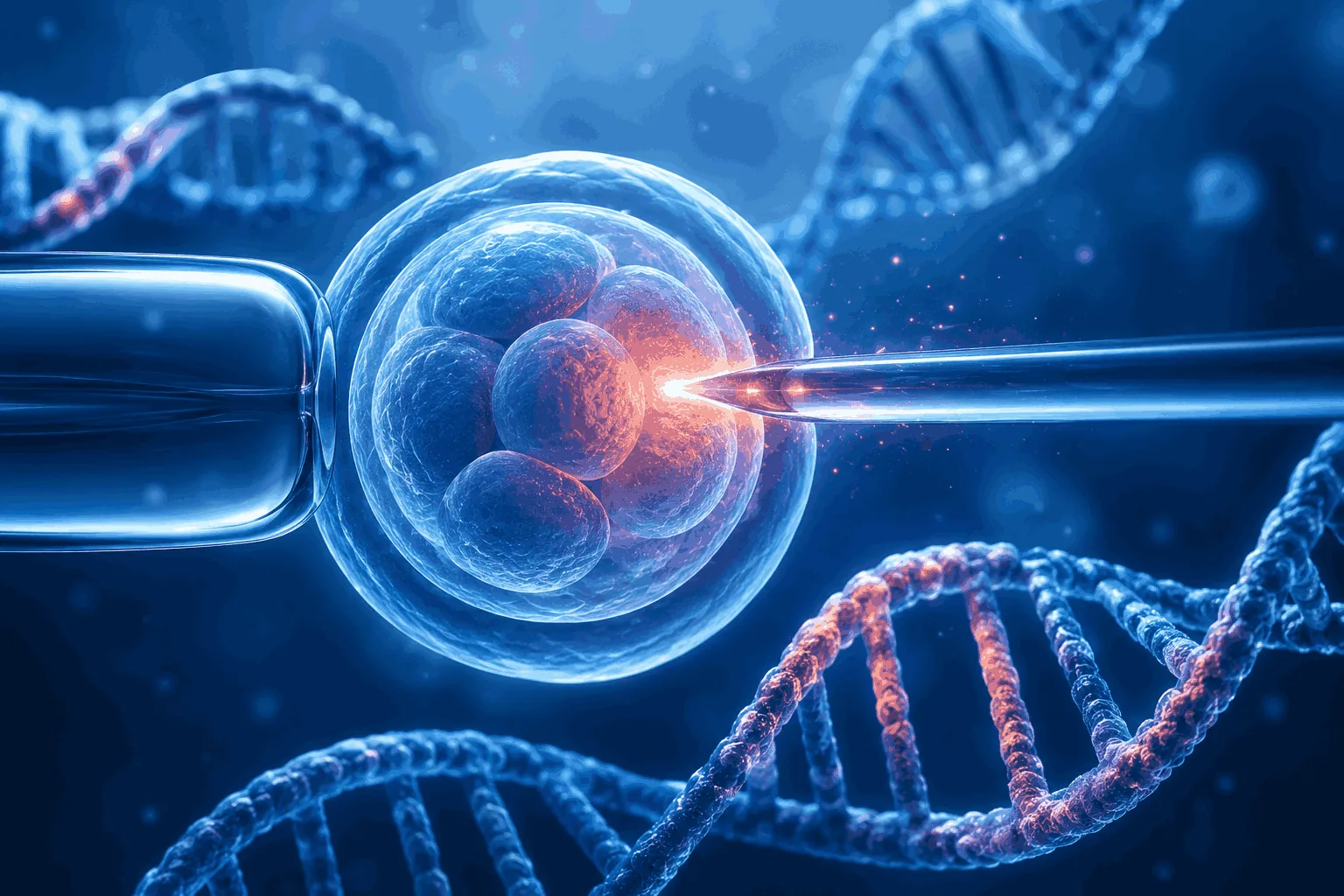
A team of scientists at Columbia University has achieved unprecedented precision in editing the DNA of human embryos using base editing, avoiding the catastrophic genomic damage that plagued earlier CRISPR experiments. Led by geneticist Dieter Egli, the researchers reported that the new technique successfully altered targeted genes without causing the massive chromosomal losses observed in previous attempts. This breakthrough, published this month, opens the door to correcting hereditary disease mutations directly in the embryo. However, it also reignites heated bioethical debates about the potential for selecting personalized traits. The method represents a significant evolution from conventional CRISPR, which had repeatedly failed to safely edit human embryos.
From Catastrophic Failures to Targeted Precision
The laboratory of Dieter Egli had firsthand experience with the dangers of traditional CRISPR editing. In 2020, when they tested the standard tool to correct a mutation causing hereditary blindness in the EYS gene, half of the embryos failed to repair the cut properly. Instead, they lost large segments of DNA or suffered complete destruction of the chromosome. Egli described those outcomes to The New York Times as having “absolutely catastrophic consequences,” which prompted the shift toward base editing. This newer approach, originally developed by David Liu in 2016, chemically converts one DNA base into another without breaking the double helix, thus avoiding the collateral damage of CRISPR-based cuts.
Simultaneous Gene Editing Achieved
To test the precision of the base-editing method, Egli’s team introduced the molecular editors into donated fertilized eggs and two-cell embryos. They targeted two specific genes: PCSK9, which is linked to high LDL cholesterol and heart disease risk, and HBG, which controls fetal hemoglobin production. The scientists successfully altered both genes, even simultaneously within the same embryo, without detecting the massive chromosomal damage that had made standard CRISPR unusable. This achievement directly addresses a critical limitation that had stalled embryo editing research. The demonstration of dual-gene editing suggests a path toward correcting multiple disease-linked mutations at once.
The Persistent Challenge of Mosaicism
Despite the improved safety profile, the current efficiency of base editing is far from perfect. In some cases, the editing molecules failed to locate their genetic target, resulting in a condition known as mosaicism, where the embryo contains a mix of edited and unedited cells. If such an embryo were allowed to develop, the presence of two different genetic versions of the same gene could lead to unpredictable medical problems. Fertility specialist Paula Amato of Oregon Health & Science University, who was not involved in the study, called the method “promising” but stressed the need to review final data once the research, currently under peer review, is published in a scientific journal. To reduce mosaicism, future experiments will test editing in embryos at the approximately 100-cell stage, the point at which fertility clinics typically freeze and evaluate genetic material.
Private Funding and Ethical Controversy
Because the U.S. federal government does not fund research on human embryos for study purposes, the next phase of experiments will be financed by the private company Nucleus Genomics. Nathan Treff, the company’s clinical director and a coauthor of the study, argued that correcting harmful mutations would benefit in vitro fertilization (IVF) patients by allowing the implantation of embryos that would otherwise be discarded for medical reasons. Founded in 2021, Nucleus Genomics also engages in disease tracking and risk prediction for diabetes and heart conditions, and analyzes genes linked to height and intelligence. The company stirred strong controversy by placing advertisements in New York City subway stations with the slogan “Have your best baby,” drawing criticism from geneticists who questioned the accuracy of its IQ predictions and accused the firm of promoting a biotechnological form of eugenics. Kaitlyn Gallacher, the company’s head of communications, rejected those accusations, stating that Nucleus sees itself as “a natural path to eventually bring technologies like this into clinical care as part of a broader genetic platform—a complete set of ‘Genetic Optimization.’”
Critics Warn Against ‘Baby Enhancement’
Geneticist Fyodor Urnov of the University of California, Berkeley, voiced strong opposition to using the technique in embryos. Urnov argued that conventional screening for abnormalities in IVF, which has been performed safely more than 15 million times since 1978, is far more logical than resorting to a procedure whose risks may never be fully eliminated. “What they are really doing is providing ‘baby enhancers’ with an instruction manual for incursions that cross ethical boundaries,” Urnov wrote in an email to the newspaper. However, the actual feasibility of altering complex human traits is constrained by biology itself, since most human characteristics are influenced by hundreds or even thousands of genes. Egli noted that rewriting multiple genes simultaneously dramatically increases the chance of failure in the process.
Biological Limits and the Road Ahead
Egli estimated that it might be possible to safely combine alterations to three, four, or perhaps five genes in the same embryo, but he concluded that the exact limit for such manipulation still needs to be determined by further studies. The prospect of modifying complex traits like intelligence or height remains distant due to the involvement of numerous genes and the high likelihood of mosaicism in multiple edits. Meanwhile, the ethical debate intensifies: on one side, the promise of curing hereditary diseases while still in the embryo; on the other, the fear that the technology could be used for genetic enhancement, crossing moral boundaries. The scientific community is awaiting the final publication of the study, which is currently under peer review, to rigorously evaluate the safety and efficacy data. Until then, base editing in human embryos remains an experimental tool, surrounded by both hope and controversy.