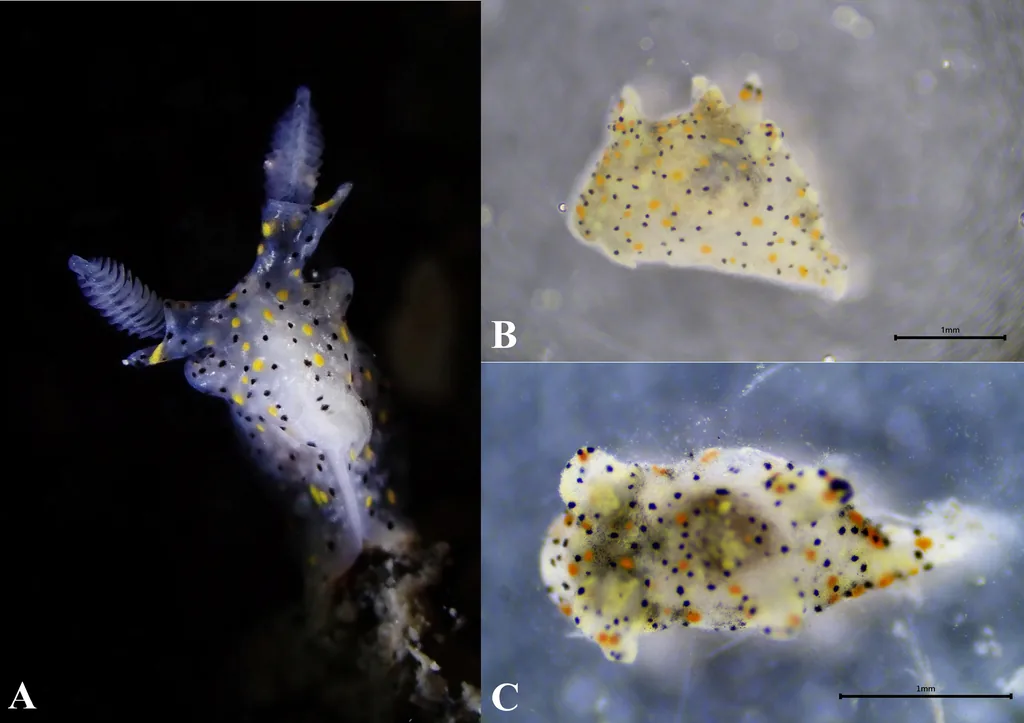
A newly identified sea slug smaller than a sesame seed has been discovered in the coastal waters near Keelung, Taiwan. The species, named Thecacera sesama, belongs to the nudibranch group—shell-less mollusks—and measures less than three millimeters. Its minuscule, translucent body, dotted with black and yellow spots, surprised scientists. The finding was published in the journal ZooKeys.
A Diminutive Creature Redefines Genus Limits
For nearly two centuries, biologists believed the genus Thecacera comprised six known species ranging from half a centimeter to one centimeter. The new discovery, however, challenges this assumption. Thecacera sesama measures well under three millimeters, a dramatic downward shift in size. Its transparent body with scattered pigmentation gives it a striking resemblance to a sesame seed.
Discovery Nearly by Chance in Keelung
The find occurred near the Keelung port, a coastal zone with beaches, rocky coves, and heavy fishing activity. Researcher Ho-Yeung Chan first observed the animal while still a student. Years later, with help from specialist Hsini Lin, he confirmed it was an undescribed species. Local conditions—only a few suitable diving months per year—make observing such tiny organisms difficult, explaining why this creature went unnoticed for so long.
Genetic Analysis Confirms Novel Species
Scientists performed genetic analyses showing that the new slug exhibits about 14.17% divergence from its closest relative, Thecacera picta. Its position on the evolutionary tree indicates it is a sister species within the genus. Differences in coloration and body pattern further supported its status as a distinct species. The study emphasizes that combining morphological and molecular evidence was essential to validate the novelty.
Association with Bryozoans Reveals Habits
The species was observed in association with bryozoans—marine organisms that serve as both food and substrate. Researchers documented behaviors including feeding, foraging, mating, and egg-laying, suggesting Thecacera sesama has established a complete life cycle in the local environment. These observations indicate a specific ecological role, even at a microscopic scale. The interaction also points to possible dependence on this resource for survival.
Implications for Western Pacific Marine Biodiversity
According to the researchers, sea slugs like this play an important role in marine ecosystems and may signal the existence of other unknown species in the Western Pacific region. The find reinforces the idea that even areas near urban centers can harbor undiscovered species. For scientists, the discovery highlights the need for ongoing field studies and the use of genetic techniques in identifying new organisms. The case also suggests that marine biodiversity in the Western Pacific may be far richer than previously assumed, especially among microscopic or hard-to-observe organisms.