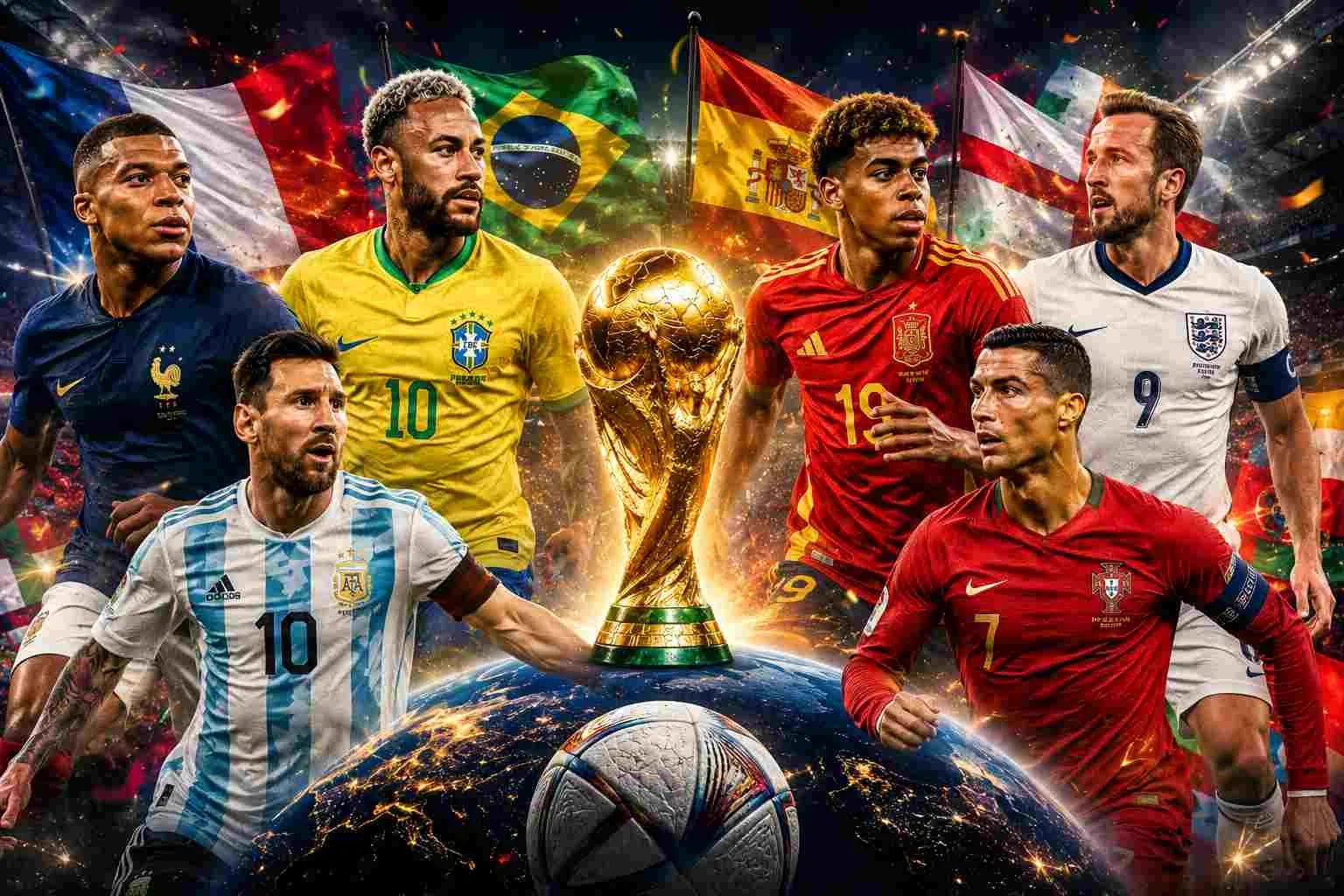
The 2026 FIFA World Cup, featuring an expanded 48-team field hosted across the United States, Canada, and Mexico, is already shaping up as one of the most balanced editions in recent memory. Thousands of fans worldwide are searching daily for information on the top contenders, with queries such as “World Cup 2026 favorites” and “who will win the World Cup” surging in volume. The global interest reflects a tournament where several national teams arrive with talented generations, deep rosters, and soaring expectations. This year’s competition marks a historic shift not only in scale but also in the sheer number of plausible champions, making the race for the trophy exceptionally unpredictable.
Analyzing the Top Contenders for the 2026 Trophy
Teams that have won the World Cup in the past share common traits: balanced squads, international experience, and depth on the bench. Tactical stability and the presence of players capable of deciding matches are also decisive factors. Furthermore, nations that perform well in continental tournaments and qualifiers tend to show greater consistency during the World Cup itself. The ability to withstand pressure is another crucial element — in a short tournament, a single moment can alter the fate of an entire country, as history has repeatedly shown.
France: The Strongest Candidacy
France appears on virtually every list of preferences for 2026. The French squad has built one of the strongest generations in recent international football history, blending youth, experience, and technical quality across all positions. Kylian Mbappé leads a team that won the title in 2018 and reached the final in 2022, demonstrating rare consistency in consecutive World Cups. The French offensive sector is considered among the most formidable, combining speed, creativity, and finishing efficiency that threaten any opponent. The experience of many players in Champions League finals further provides a significant psychological edge. The attack features athletes from Europe’s biggest clubs who know how to decide knockout games, and the depth of the squad allows the coach to make substitutions without losing quality — a luxury rarely seen at this level. For these reasons, analysts widely regard the French as the leading contenders for the trophy.
South American Powerhouses and European Challengers
Brazil, the most successful nation in World Cup history, is seeking to expand its collection of titles and return to the top of global football. The country’s talent production continues at an impressive pace, with players active in major European leagues offering multiple tactical options. The combination of individual skill, offensive tradition, and international experience keeps Brazil among the natural candidates for the trophy. The weight of the yellow and green shirt still commands respect from any opponent, and the team’s recent performances in qualifiers underline its strength. Argentina arrives buoyed by its 2022 title and has firmly entered the group of top favorites. Lionel Scaloni’s squad has developed an extremely competitive identity, with defensive organization, physical intensity, and technical quality. Even after the Lionel Messi era, the Argentines maintain a strong generation capable of facing any side. The competitive spirit demonstrated in recent years further strengthens their chances in the World Cup.
Spain, England, and Portugal: The New European Cohort
Spain is undergoing a promising renewal, with young talents who have transformed the team into one of the most dynamic in international football. Known for controlling possession and dictating the tempo, the squad combines tactical tradition with speed and creativity. Many experts consider Spain one of the most dangerous candidates due to the quality of its youngsters and recent evolution. England carries enormous expectations, with a squad frequently cited as one of the most valuable on the planet. The big question for the English is maintaining regularity throughout the tournament and avoiding fluctuations in decisive moments. Portugal has consolidated its status as a global power, revealing high-level players even after the peak of Cristiano Ronaldo. With solid tactical organization and technically gifted athletes, the Portuguese appear as a real threat to the traditional favorites.
Dark Horses and the Impact of the Expanded Format
It is never wise to underestimate Germany in a World Cup. The German side possesses a winning tradition, exemplary structure, and a history of growing stronger as tournaments progress. Even during periods of renewal, the Germans find ways to become competitive in the decisive stages. If they can adjust their system and harness the available talent, they could emerge as one of the biggest surprises. Beyond the traditional favorites, teams such as Morocco, Croatia, the Netherlands, Belgium, Uruguay, and Denmark have the quality to challenge established powers and reach advanced rounds. The new 48-team format further increases the possibilities for upsets, making this World Cup one of the most unpredictable in history.
Star Players and Statistical Models
Major tournaments are often decided by players capable of changing games in seconds. Names like Kylian Mbappé, Jude Bellingham, Vinícius Júnior, Lamine Yamal, Rodrygo, Julián Álvarez, and Harry Kane arrive at the World Cup with enormous expectations. The ability of these stars to decide knockout matches can be decisive for who lifts the trophy. Modern statistical analyses consider squad market value, recent performance, offensive efficiency, defensive consistency, and group depth. France, Brazil, Argentina, Spain, and England repeatedly appear among the highest-rated teams in prediction models. However, history shows that favoritism does not guarantee titles — details, individual moments, and emotional factors can completely alter the outcome of a competition. If one were to point to a main group of candidates, France, Brazil, Argentina, and Spain stand slightly ahead. France arguably has the most complete squad; Brazil boasts enormous tradition and individual talent; Argentina arrives energized by recent success; Spain presents one of the most promising generations. Right behind come England, Portugal, and Germany — teams capable of beating any opponent in knockout matches. The 2026 FIFA World Cup brings together some of the most talented national teams ever assembled in a single tournament, with global stars, emerging generations, and millions of fans watching every match. Regardless of who lifts the trophy, the race for the world title promises to be one of the most thrilling in football history.