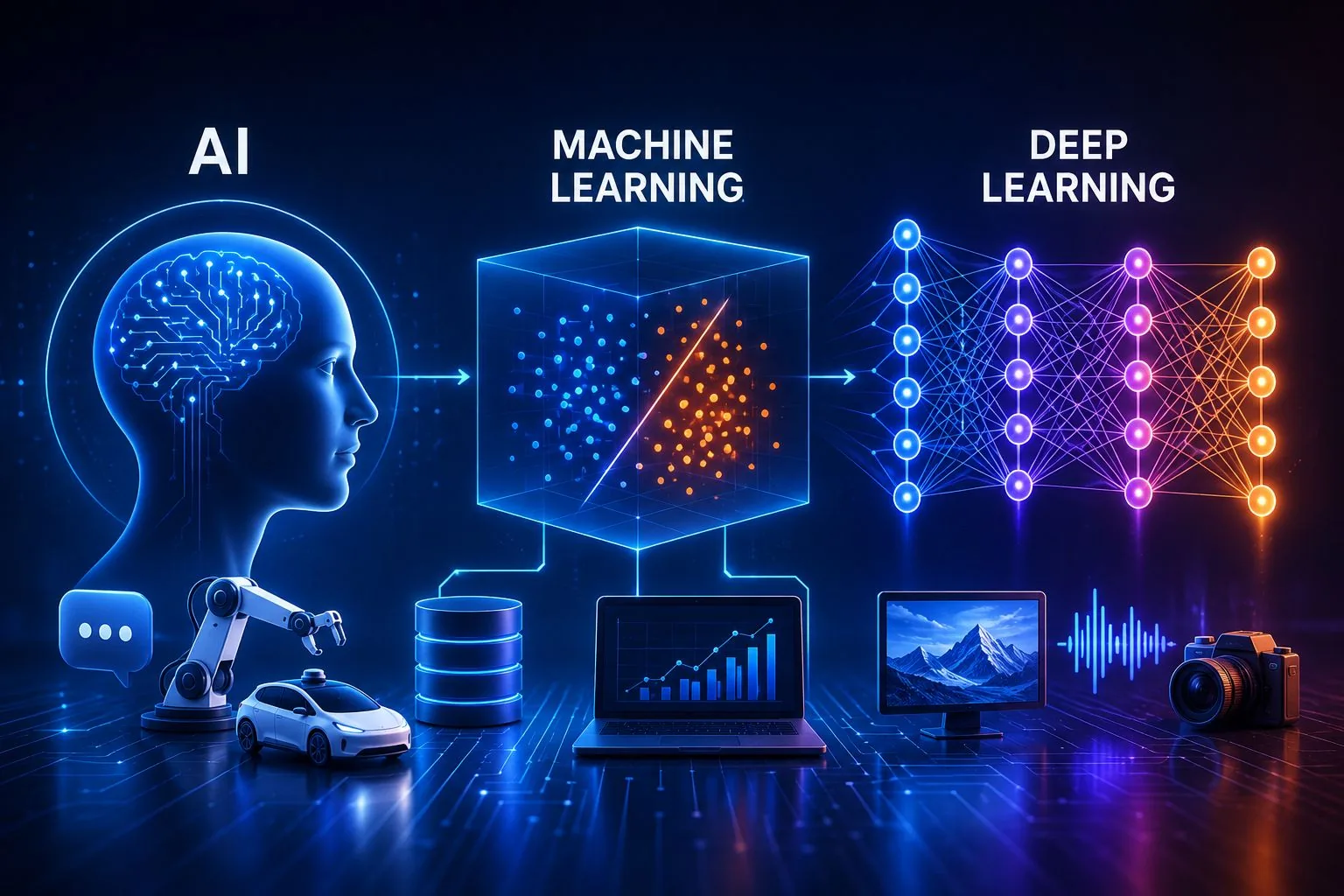
The world of computing is undergoing a profound transformation, and at its heart are three closely related but distinct technologies. Artificial Intelligence, Machine Learning, and Deep Learning are not synonyms; they represent a hierarchy of capability that has captivated investors, governments, and researchers worldwide. Billions of dollars are being poured into solutions that automate tasks, analyze massive data sets, and make intelligent decisions. Yet confusion persists over what each term actually means and how they differ. This guide distills the essential distinctions and shows why they matter for anyone navigating the digital future.
What Exactly Is Artificial Intelligence?
Artificial Intelligence is the broadest of the three concepts, encompassing any computer system capable of performing tasks that would normally require human intelligence. These tasks include pattern recognition, learning, problem solving, decision making, and understanding natural language. The term was officially introduced during the Dartmouth Conference in 1956, widely regarded as the birth of modern AI research. Since then, scientists have steadily developed methods to build machines that mimic intelligent behavior. The overarching goal of artificial intelligence is to make computers perform functions that once depended entirely on humans.
- Virtual assistants
- Customer service chatbots
- Recommendation systems
- Automatic translators
- Facial recognition
- Self-driving cars
- Content generation tools
Machine Learning: Learning from Data
Machine Learning, or Aprendizado de Máquina, is a subfield of artificial intelligence. Instead of manually programming every rule, developers allow systems to learn patterns directly from data. This concept revolutionized technology by enabling algorithms that improve their performance over time. According to researchers at Stanford University, machine learning has become one of the primary methodologies for solving complex problems that involve prediction and data classification. The process typically involves collecting data, preparing information, training a model, testing its performance, and then applying it in real-world scenarios.
- Data collection
- Information preparation
- Model training
- Performance testing
- Real-world application
During training, the algorithm identifies patterns and learns to make predictions. The more high-quality data available, the more accurate the model tends to become. Common practical applications include email spam filters, weather forecasting, bank fraud detection, movie and music recommendations, computer-assisted medical diagnoses, and consumer behavior analysis.
- Email spam filters
- Weather forecasting
- Bank fraud detection
- Movie and music recommendations
- Computer-assisted medical diagnoses
- Consumer behavior analysis
Deep Learning: The Next Evolution
Deep Learning is an evolution of machine learning that uses structures called deep artificial neural networks to process enormous amounts of data. These networks are inspired by the way neurons function in the human brain. Unlike traditional machine learning models, deep learning systems can automatically identify complex features in data. This capability allows them to solve extremely difficult problems involving images, voice, and natural language. The term "deep" refers to the multiple layers present in modern neural networks, each layer analyzing different aspects of the information. As data passes through these layers, increasingly sophisticated patterns are identified.
- Advanced facial recognition
- Autonomous vehicles
- Medical exam analysis
- Intelligent voice assistants
- Real-time automatic translation
- Generative text AI
- AI image creation
How the Three Concepts Relate
A simple way to understand the relationship is to imagine concentric circles. Artificial intelligence is the largest circle, containing machine learning inside it, and within machine learning lies deep learning. Therefore, every deep learning system is also machine learning, and every machine learning system is part of artificial intelligence. However, not all artificial intelligence uses machine learning, and not all machine learning uses deep learning. This hierarchy is important because it clarifies that deep learning is a specialized subset of machine learning, which in turn is a subset of artificial intelligence.
- All deep learning is machine learning.
- All machine learning is part of artificial intelligence.
- Not all artificial intelligence uses machine learning.
- Not all machine learning uses deep learning.
| Characteristic | AI | Machine Learning | Deep Learning |
|---|---|---|---|
| Scope | Broad | Intermediate | Specialized |
| Data Requirement | Low to medium | High | Very high |
| Computational Power | Medium | High | Very high |
| Image Recognition | Limited | Good | Excellent |
| Language Processing | Basic | Good | Advanced |
Driving Forces and Challenges
The rapid advancement of artificial intelligence in recent years has been driven by three main factors. First, the explosive growth of data: humanity now produces gigantic quantities of information daily from social media, mobile devices, sensors, and corporate systems, generating trillions of data points constantly. Second, more powerful computing: companies such as NVIDIA, AMD, and Intel have developed extremely efficient processors for training advanced models. Third, scientific advances: researchers have created more efficient neural network architectures and algorithms capable of learning with much greater precision.
In recent years, a new category — generative AI — has gained worldwide prominence. These systems use deep learning to create original content, including texts, images, videos, music, and computer programs. This technology is transforming entire sectors of the global economy. At the same time, intelligent automation is reshaping many professions; new opportunities are emerging in fields such as data science, AI engineering, machine learning engineering, cybersecurity, data analysis, robotics, and industrial automation. Experts believe that professionals with knowledge of artificial intelligence will be among the most sought-after in the coming decade.
Despite impressive advances, significant challenges remain. These include data privacy, algorithmic bias, energy consumption, digital security, transparency of automated decisions, and international regulation. Organizations such as the OECD and UNESCO have been discussing global guidelines for the responsible development of artificial intelligence. The coming decades promise even greater advances, with expectations of significant improvements in personalized medicine, adaptive education, scientific research, business automation, and sustainability. The combination of AI, machine learning, and deep learning is expected to redefine how people and organizations work, learn, and communicate.
Although the terms are often used interchangeably, artificial intelligence, machine learning, and deep learning have important differences. AI is the general field of creating intelligent systems; machine learning is a technique that allows machines to learn from data; and deep learning uses deep neural networks to solve highly complex problems. Understanding these distinctions is essential for keeping pace with one of the greatest technological revolutions in modern history. This comprehension is vital for anyone seeking to engage with the technologies that are shaping our future.