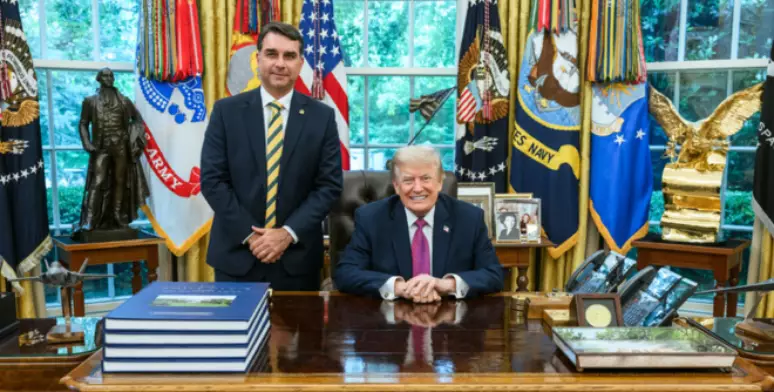
A fabricated image that surfaced on social media Tuesday purported to show Brazilian Senator Flávio Bolsonaro seated beside former U.S. President Donald Trump in the Oval Office, but fact-checkers have confirmed the photograph was entirely created by artificial intelligence. The deceptive post circulated rapidly before any official images from the actual meeting were released, fueling confusion and controversy online. The photo, which showed the lawmaker in a blue tie seated to the right of the former U.S. president, was later debunked by multiple verification systems. No official images from the meeting had been released at the time of the post, leaving room for the false narrative to take hold. The episode underscores the growing threat of AI-generated disinformation targeting high-profile political events.
How the Fake Image Spread
The misleading upload appeared on X at 2:30 PM Tuesday accompanied by a caption claiming urgency and alleging that leaked photos showed the meeting between Trump and Flávio Bolsonaro. The caption further asserted that the revelation would send the left into despair, a clear attempt to provoke an emotional reaction. In the AI-generated scene, Flávio Bolsonaro wears a blue tie and sits to Trump's right, while Eduardo Bolsonaro is depicted observing from the president's left. Importantly, the post contained no disclosure that the image was synthetic, which likely contributed to its widespread sharing before verification could occur.
A Subtle but Telling Detail
A small marker in the bottom right corner of the frame displayed the Gemini symbol, identifying the image as a product of Google's artificial intelligence model. Despite this indicator, few users noticed or heeded it, and the poster did not flag the image's artificial origin. The Fato ou Fake project, a fact-checking initiative by G1, was subsequently activated to investigate the photograph's authenticity. Their analysis would rely on multiple detection tools to confirm what the Gemini seal already hinted at.
Detection Tools Confirm AI Fabrication
Three distinct synthetic content detectors were employed to assess the image, and all returned conclusive evidence of AI generation. Google's SynthID Detector, which embeds an invisible watermark imperceptible to the naked eye, identified the content as having been created specifically with the company's AI models. This technology can recognize synthetically produced video, audio, text, and images even when the watermark is not visually apparent to humans. The system's findings provided a strong foundation for the fact-checking conclusion.
Overwhelming Probability Scores
Additional tools reinforced the determination. Hive Moderation assigned a 99.9 percent probability that the photograph was artificially generated, while Sightengine indicated a 99 percent likelihood of synthetic origin. The results were disclosed by Fato ou Fake, which also sought clarification from the office of Senator Flávio Bolsonaro. The senator's press team categorically denied the image's authenticity, pointing to a straightforward discrepancy in attire.
Official Denial and the Real Photo
According to the senator's press office, in the genuine photographs from the encounter, Flávio Bolsonaro was wearing a green and yellow tie—not the blue one shown in the fake image. The official photograph, released later, depicts the senator standing next to a seated Donald Trump, a composition markedly different from the fabricated seating arrangement. The contrast between the false and authentic records exposes a deliberate attempt to mislead the public. The timing of the fabricated image's circulation, occurring before the official photos were made available, amplified its deceptive impact.
The Broader Implications of AI Disinformation
This incident illustrates the heightened risks posed by artificial intelligence tools capable of generating hyper-realistic scenes without referencing any real source material. The episode took place during a sensitive window when the public was eagerly awaiting official documentation of the political meeting. The rapid spread of the fake content highlights the ease with which misinformation can outpace truth in the digital ecosystem. Fact-checkers emphasize the critical importance of verifying the origins of viral materials before sharing them, as even seemingly convincing images may be entirely synthetic.