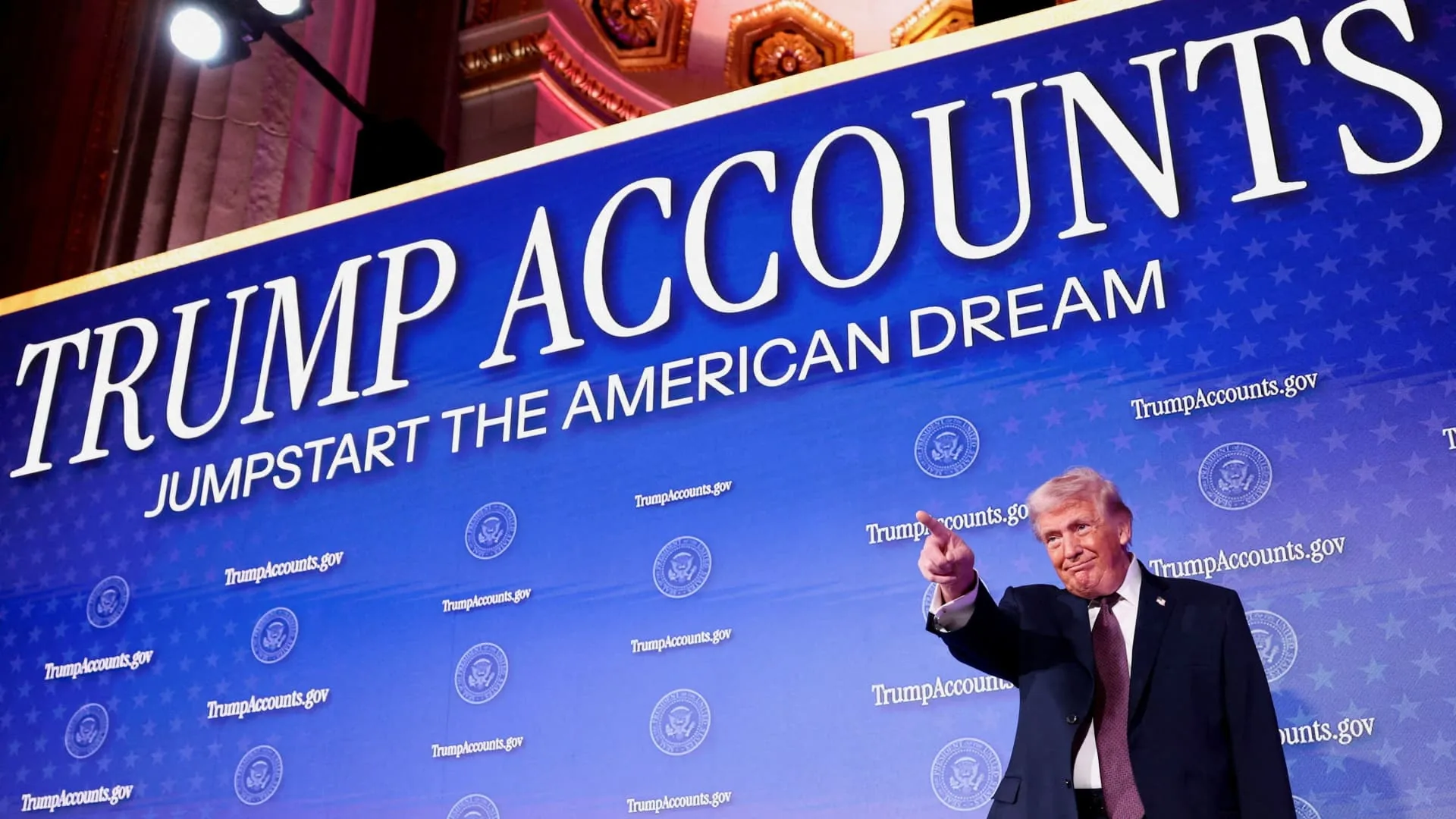
Nearly 6 million children have been enrolled in Trump Accounts, a new tax-advantaged savings vehicle set to officially launch on July 4, according to recent enrollment data. These accounts, formally designated as 530A accounts, provide families with an unprecedented pathway to build retirement savings for minors. For eligible children, the initial grant from the Treasury Department — worth up to $1,000 — serves as a powerful incentive. But even those who do not qualify for that seed money can use a sophisticated strategy typically reserved for older investors: converting funds into a Roth individual retirement account.
How Trump Accounts Create a Roth IRA Backdoor
Financial planners emphasize that Trump Accounts are fundamentally different from traditional retirement vehicles because they allow contributions without requiring the beneficiary to have earned income. Under current rules, a child cannot hold a Roth IRA unless they earn wages, a salary, or similar compensation. Trump Accounts bypass that barrier entirely, enabling families, friends, and employers to contribute money that can later be moved into a Roth IRA. Adam Bergman, founder of IRA Financial and a tax attorney based in Miami, described this as “a legal backdoor into a Roth IRA that does not require a child to have earned income.” He added that this represents “a meaningful expansion families are not hearing about.”
Contribution Limits and Tax Treatment
The accounts accept a mix of pretax and after-tax dollars, subject to varying rules. Parents, guardians, and grandparents can contribute up to $5,000 annually in after-tax funds per child until the year before the beneficiary turns 18; those contributions can be withdrawn tax-free. Employers may contribute up to $2,500 per worker per year, which counts toward the overall limit but does not count as taxable income. Qualifying charitable organizations and state and local governments can also make contributions that do not count toward the $5,000 cap. The Treasury’s $1,000 seed money, along with employer matches and charitable gifts, goes into the account pretax, meaning those amounts will be taxed as ordinary income upon withdrawal. All funds inside the account grow tax-deferred until distribution.
The Roth Conversion Strategy: Timing and Tax Implications
The core opportunity for young account holders lies in converting pretax or nondeductible funds — including the seed grant, employer matches, and philanthropic gifts — into a Roth IRA. This conversion triggers an income tax liability, but financial planners note that the bill can be minimized if executed early in the beneficiary’s career. The ideal window is typically between ages 18 and the mid-20s, when the individual’s income and tax rate are likely low. Ben Henry-Moreland, a certified financial planner with Kitces.com, explained that after conversion, the funds can grow tax-free until retirement. In some cases, if the converted amount is less than the standard deduction — $16,100 for single taxpayers in 2026 — the child may owe no federal income taxes at all.
Retirement Accounts First, Not Education Savings
Financial advisors caution that Trump Accounts should be viewed primarily as retirement tools, not as general savings accounts for expenses like college. Jeffrey Levine, a certified financial planner and CPA based in St. Louis, warned that contributing beyond the initial $1,000 grant may not make financial sense if the money is intended for higher education. “They generally should be thought of as retirement accounts first, and not for other purposes,” he said. For education, 529 college savings plans offer tax-free growth and withdrawals for qualified expenses, giving them a clear advantage in most circumstances, according to Levine.
The Kiddie Tax: A Major Risk to Conversions
A significant pitfall for the Roth conversion strategy is the so-called “kiddie tax” — an extra levy on a child’s unearned income exceeding a certain threshold. Currently, that threshold is $2,700. If the converted amount pushes unearned income above that level, the excess is taxed at the parents’ marginal rate, which could be as high as 37% federally. Cary Sinnett, senior manager of personal financial planning at the Association of International Certified Professional Accountants, called this “the largest technical risk” to the conversion approach. The kiddie tax always applies to children under 18 with unearned income, and may apply up to age 24 if the child is still a dependent or a student supported by parents. Sinnett advised that the safest way to avoid the kiddie tax is to ensure the child is over 24 before converting.
Another concern is how to cover the taxes due on the converted balance. If the account owner lacks outside funds and parents are unwilling to help, they may need to withdraw money from the account to pay the tax. Henry-Moreland noted that such a withdrawal would itself be treated as a taxable distribution and would incur a 10% early withdrawal penalty. That would reduce the amount left to compound tax-free, undermining the long-term benefit of the conversion. Financial planners suggest parents could make a tax-free gift to their child — up to the annual gift exclusion of $19,000 in 2026 — to cover the tax liability without triggering additional penalties.