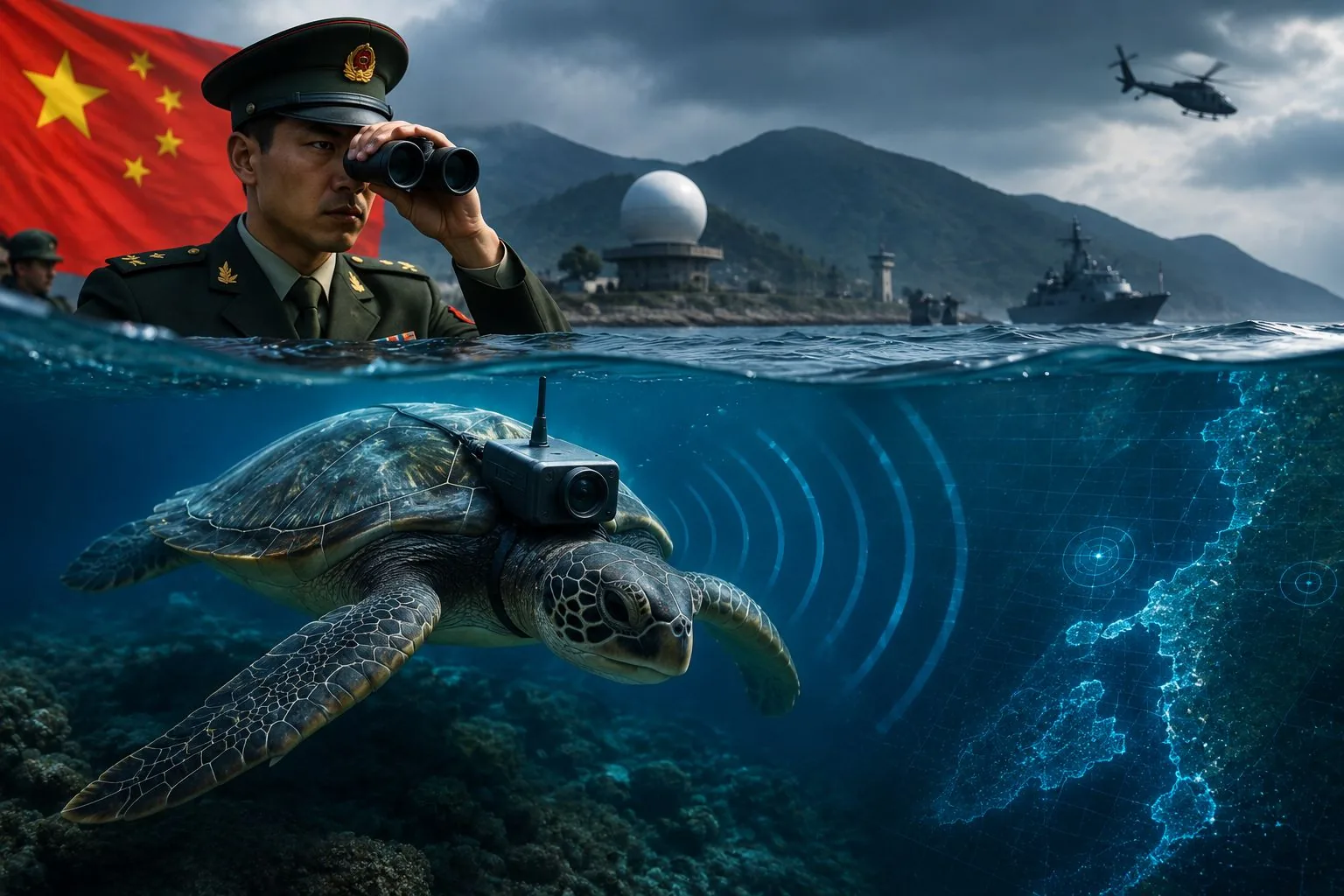
China has accused foreign intelligence services of deploying sea turtles equipped with espionage sensors to map its coastline, according to a statement from the Ministry of State Security. Beijing announced the accusation on social media, claiming that new-type espionage equipment had been detected on marine animals, including fish. The ministry classified the practice as a serious threat to national security, though it did not name any specific country or agency. The revelation comes amid an escalation of mutual espionage accusations between China and several Western nations.
The ministry's statement, published in a section titled "spy turtles, spy fish," reported that large marine animals were found with sensors attached in certain Chinese waters. These sensors, the ministry said, could collect data on water temperature, salinity, and ocean currents — information that could be transmitted abroad via satellite. Beijing considers that such data could be used to identify weak points in the country's coastal defenses, posing a direct threat to national sovereignty. The official note did not mention any particular country or agency but made clear the practice is viewed as a hostile act of espionage.
Spy Sensors and Data Collection Capabilities
The sensors represent an advanced method of intelligence gathering, designed to go undetected by traditional monitoring systems. The collected oceanographic data is considered critical for naval operations and coastal security. China's concern centers on the possibility that such information could be exploited to compromise defensive positions. The ministry emphasized that the transmission capability via satellite makes the threat particularly severe. The type of sensors described would allow foreign agencies to build detailed models of China's underwater environment.
Appeal for Vigilance from Fishermen and Import Checks
The ministry appealed to fishermen to report any unusual buoys or devices found at sea. It also recommended conducting safety checks on all equipment received from abroad. This suggests Beijing fears that hidden monitoring instruments could be introduced through imported devices. The move reflects growing paranoia around marine data security, which is deemed vital for China's coastal defense. The authorities are urging citizens to cooperate in safeguarding state secrets.
Mutual Espionage Accusations Escalate Between China and the West
Over recent months, China has exchanged espionage accusations with several governments, widening diplomatic tensions. Last month, Beijing reacted to the conviction of two men in the UK for espionage against Hong Kong dissidents by calling it a "political farce" and accusing the UK of "erroneous practices." The response came as the international community closely watches Chinese intelligence activities abroad. The situation demonstrates that espionage has become a central point of friction in bilateral relations. The war of words shows no sign of abating.
Recent Cases of Suspected Espionage Involving China
- In May, German police arrested a couple suspected of spying for China, accusing them of seeking information on advanced technology with military applications.
- In February, French authorities charged four people, including two Chinese citizens, with suspected interception of sensitive military data, as reported by Agence France-Presse.
- In the same month, Greek military authorities detained a colonel suspected of providing confidential and highly secret information to China, according to the Greek National Defense General Staff.
These events run parallel to the spy turtle accusation, suggesting that China is increasingly the target of espionage claims while it also levels its own allegations against foreign governments. The lack of concrete evidence in many of these cases raises questions about the veracity of the accusations and their use as a political tool. Critics argue that Beijing's unsubstantiated claims may be designed to justify increased surveillance and control over maritime information. Others see the accusations as a response to mounting espionage allegations against Chinese nationals abroad. The truth behind the spy turtle story remains elusive, but its political impact is already being felt.