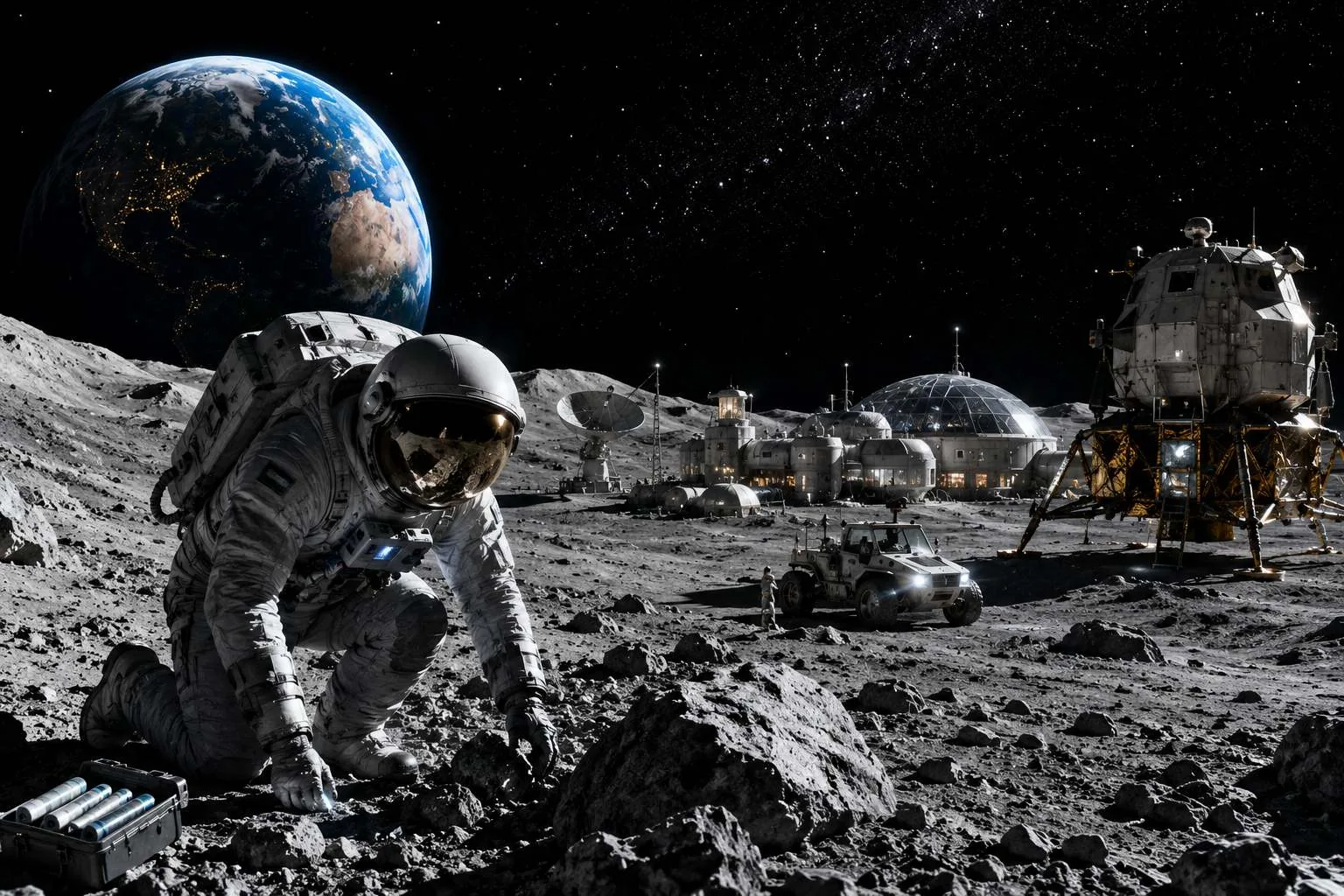
The new space race is already in full swing, decades after the Apollo landings. The United States, China, India, Japan, Russia and European Union nations are competing to establish a lasting presence on the Moon. Unlike the 20th-century rivalry, today's contest is not merely symbolic. It is a strategy encompassing science, national security and economic interests that could move trillions in the coming decades.
Why the Moon Is Once Again a Strategic Priority
After the Apollo program ended, lunar exploration lost considerable momentum. Space agencies redirected their focus toward satellites, orbital stations and robotic missions to other planets. Recent technological advances coupled with fresh scientific discoveries, however, have reignited global interest. A pivotal factor is the detection of water ice at the lunar poles, locked in permanently shadowed craters. That resource could supply drinking water, generate oxygen and even be processed into rocket fuel. Such capability would transform the Moon into a refueling depot for deeper space journeys.
Beyond water, the Moon’s proximity to Earth offers an ideal testing ground for survival technologies essential for crewed missions to Mars and beyond. Another major draw is helium-3, an isotope scarce on Earth but relatively abundant on the lunar surface. Researchers believe it could one day fuel advanced nuclear fusion reactors. Although commercial exploitation remains contingent on scientific breakthroughs, the energy potential is already intensifying the race to secure lunar footholds.
US, China and India Push Concrete Plans
The United States leads with NASA’s Artemis program, built on a network of private and international partnerships. The goal is to return astronauts to the lunar surface for the first time since 1972 — and not for a brief visit. NASA envisions a sustainable human presence featuring routine missions and permanent infrastructure. The SLS rocket, Orion capsule and planned Gateway orbital station form the program’s core. A primary objective is establishing a base near the south pole, chosen for its water ice reserves and scientific promise. The agency sees the Moon as a stepping-stone for interplanetary travel, leveraging cooperation to speed development and lower costs.
China Aims for International Science Base
China has emerged as a formidable contender, notching impressive milestones including successful robotic landings and its own orbital space station. Beijing now plans to construct an international research base on the lunar surface within the next decade. The project envisions cooperation with other nations and permanent facilities dedicated to exploration and resource extraction. Chinese officials view the Moon as essential for expanding humanity’s reach into space. Their roadmap includes precursor robotic missions, heavy equipment delivery and eventually extended astronaut stays.
India, too, has secured a prominent place in the new lunar race. Recent missions demonstrated the country’s technological prowess by landing in difficult terrain. That success elevated its standing on the global stage and opened avenues for deep-space initiatives. The European Space Agency, meanwhile, is betting on collaboration rather than an independent lunar program. Europe contributes life-support systems, habitable modules, robotics and mining technologies, a strategy that experts say will cut costs and accelerate the construction of permanent outposts.
The Role of Private Companies and the Path to Mars
Governments are not the only players driving this renewed effort. Private firms led by visionary entrepreneurs are pouring investment into reusable rockets, landing systems and cargo transport. They view the Moon not only as a scientific destination but as an emerging economic frontier. Lunar resources could become tremendously valuable as human activity expands beyond Earth. The private sector also helps slash launch expenses and spurs rapid innovation. Many specialists regard the Moon as a critical intermediate step before crewed missions to Mars. Experience gained from building and operating bases there will yield vital lessons for surviving in extreme extraterrestrial environments. The Moon’s lower gravity further simplifies launches to distant targets, positioning the satellite as a logistics hub for the Solar System.
The years ahead promise to be among the most consequential in space exploration. New robotic probes, crewed landings and permanent facilities could fundamentally alter humanity’s relationship with the Moon. The satellite that once symbolized victory in the original race now embodies an opportunity to push the boundaries of civilization. Should current plans come to fruition, the next few decades will witness the first enduring communities beyond Earth.