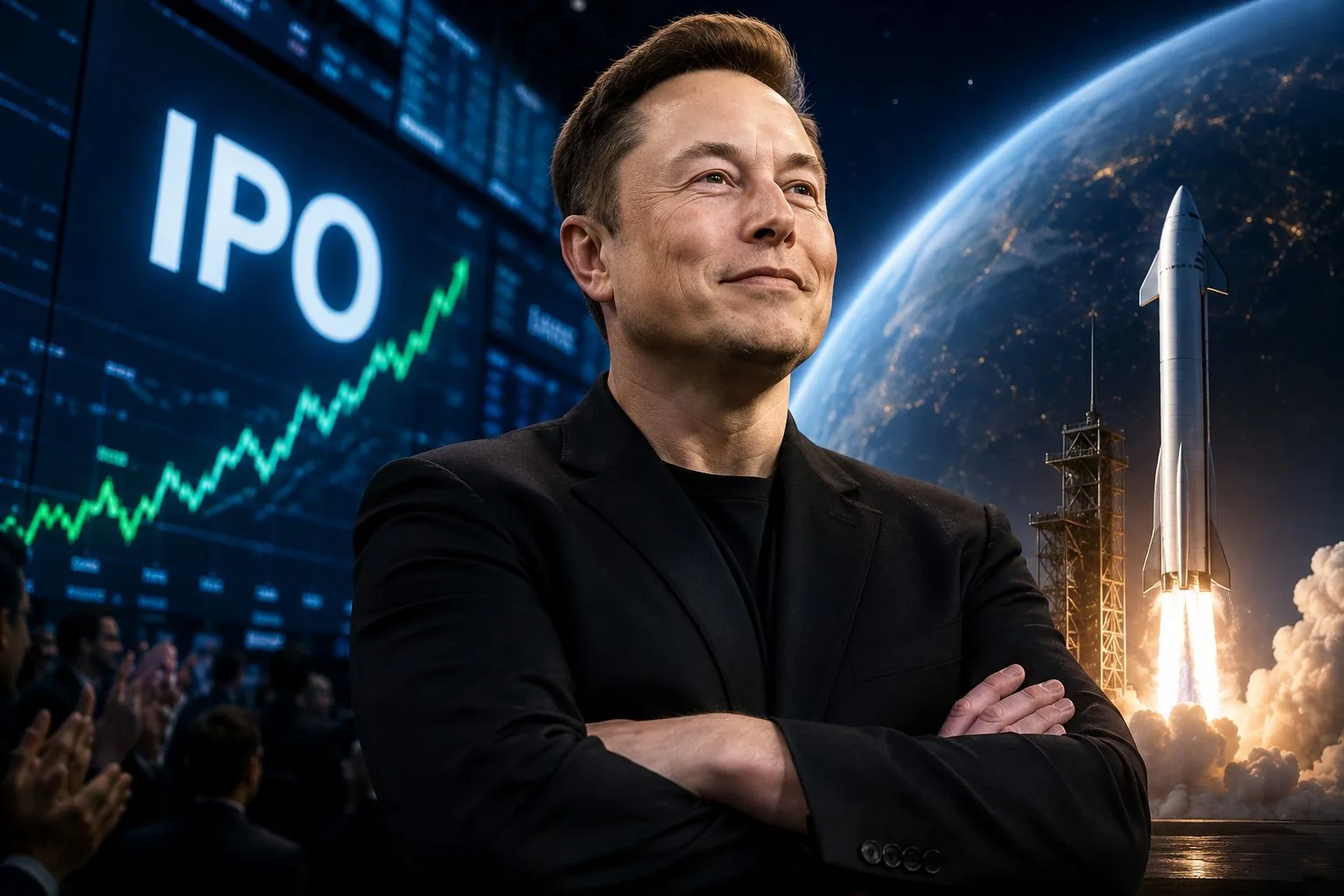
Elon Musk has become the first trillionaire in history following the initial public offering of SpaceX, a milestone that analysts argue says more about the state of the world than any space achievement. While billions of people lack basic sanitation, healthcare, and education, Musk’s personal wealth has exceeded US$1 trillion. The celebration on social media, where the fortune is hailed as a collective victory, reveals a landscape of alienation: low-income workers cheering for someone else’s riches. Musk’s wealth did not appear out of nowhere—it rests on his intelligence and timing, but also on a system that transfers resources upward.
The Socialized Costs Behind a Private Fortune
Tesla, one of Musk’s flagship companies, has accumulated reports of exhausting shifts, abusive conditions, sexual harassment, and retaliation against employees seeking better working conditions. On X, each user provides data free of charge, fueling the billionaire’s artificial intelligence platform. At various points, his enterprises have received public subsidies, multibillion-dollar government contracts, and taxpayer-funded infrastructure. SpaceX itself grew partly thanks to contracts with NASA and U.S. defense agencies. In other words, public money helped build private wealth that will never be returned to society in the same proportion. This is not pure entrepreneurship but the socialization of costs and privatization of profits at the most extreme level.
Public Money, Private Wealth
While some celebrate the fortune as an example of success or divine blessing, others already perceive the global impact. Not only have we seen the number of billionaires on the Forbes list grow, but now we witness the birth of the first trillionaire. Musk’s surge occurs while billions of people on the planet lack access to basic sanitation, quality healthcare, or decent education. It is no coincidence: the system that allows unlimited concentration of wealth in the hands of very few is the same system that ensures the majority remains vulnerable. One person’s wealth is, to some extent, the redistributed poverty of many.
Wealth Concentration as a Threat to Democracy
The problem of concentration is not envy or resentment, as those who have outsourced critical thinking to messaging apps would have us believe. It is a matter of justice. Someone with a trillion dollars possesses not just money but power—to influence elections, shape public opinion through algorithms that condition debate, decide who has access to the internet, and therefore who can communicate. He can sit next to presidents, prime ministers, and kings as if he were an equal, when in practice he is a hierarchical superior. Musk has already demonstrated all this: he bought a global communication platform for $44 billion in 2022 and turned it into a personal propaganda channel. He interfered in international conflicts by activating and deactivating Starlink services. He approached governments with the ease of someone who knows he has something the other needs. He attacked institutions in several countries when his interests collided with national laws. He helped the far right in many elections.
The Irony of the Self-Appointed Savior
Musk’s biography, written by Walter Isaacson, describes him as someone obsessed with the idea that humanity is in danger. That is why, it is said, he wants to colonize Mars and has many children. But there is a cruel irony: a man who claims to want to save humanity accumulates wealth on a scale that, by itself, represents one of the greatest dangers humanity faces—living in a world where rights cease to be universal and become proportional to the size of one’s bank account. The right question is not whether he deserves every cent, but what kind of world we are building when one individual accumulates more wealth than the GDP of entire countries while another dies from a treatable disease due to lack of medicine. When one man can send a car into space as a rocket test and there are children without food on Earth.
Proposals to Curb Inequality Gain Relevance
In this context, the proposal by Democratic Senator Bernie Sanders to tax technology giants, with a focus on artificial intelligence, gains relevance. The initiative demands that big techs pay not with profits but with 50% of their shares, creating a public fund. The justification is that AIs were created and fed using the collective knowledge of humanity. Social inequality, which should be a source of shame, has become a source of pride for many. What matters to a part of the population—both those at the top and those who dream of being there—is not to reduce the gap but to glamorize it and mythify social ascent. The individual no longer desires collective social justice, but a place in the sun for himself. The first trillionaire in history is not a human achievement. It is a symptom that humanity is doing poorly.