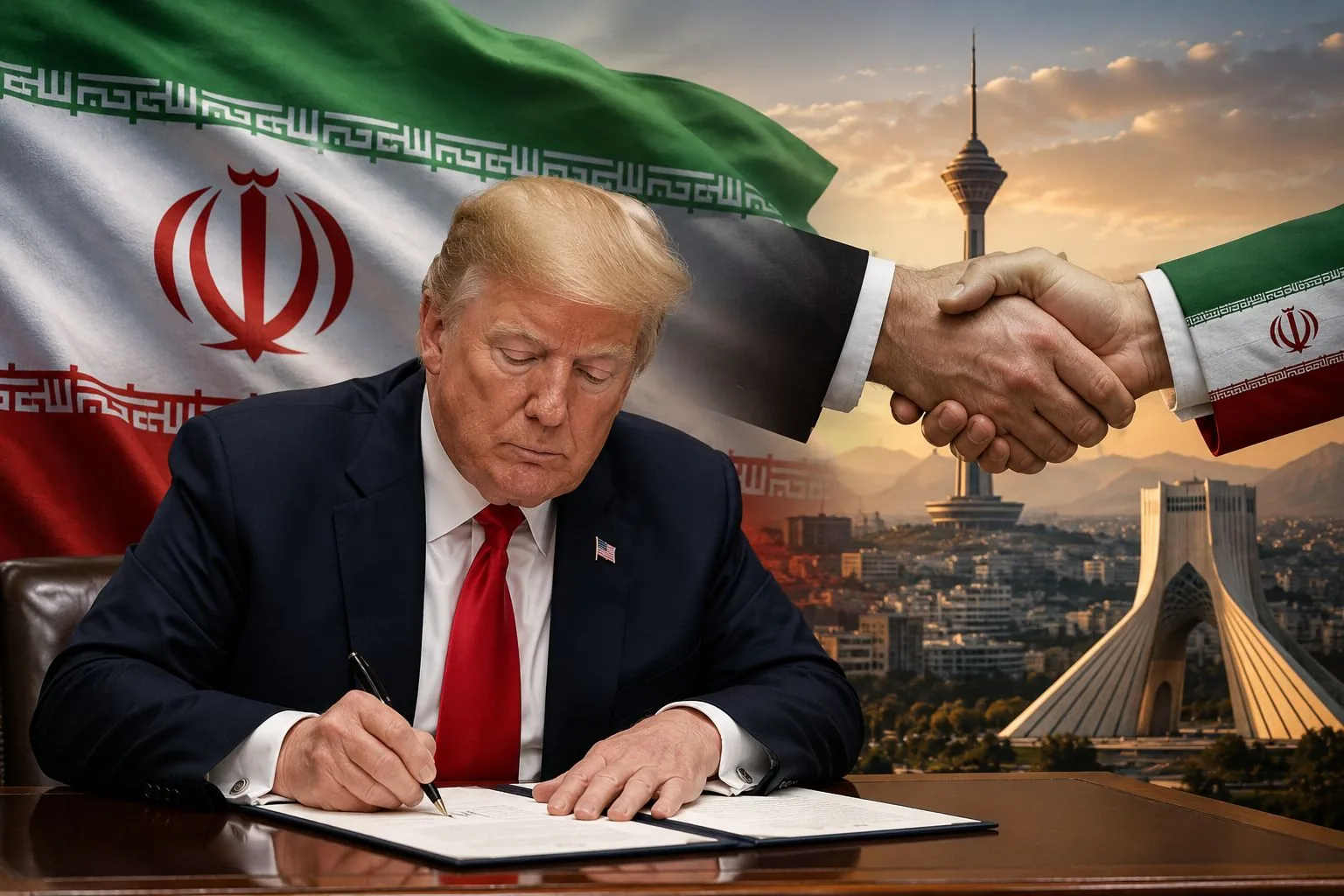
President Donald Trump announced on Thursday that a memorandum of understanding for a ceasefire with Iran will be signed by Vice President JD Vance in Europe this weekend, but the Iranian government has yet to confirm any such deal. Speaking to journalists, the Republican leader stated that the document would be finalized starting Saturday, June 13, though he offered no specific location or the name of the Iranian official expected to sign. The absence of any official confirmation from Tehran immediately raised questions about the validity of the announcement. Trump’s prediction came after days of intense U.S. military pressure against the clerical regime.
Trump's Unilateral Announcement and the Missing Iranian Signature
The president characterized the understanding as “great,” particularly because, according to him, the Iranian side agreed to refrain from developing or acquiring nuclear weapons. He expressed confidence that Iran’s current Supreme Leader, Mojtaba Khamenei, had accepted Washington’s conditions. “We were attacking them very hard in the last three days. We were going to attack them even more tonight,” Trump told reporters, adding that the United States had explained in “meticulous detail” exactly what it would do because, he claimed, Iran lacks a navy and air force capable of retaliation. Despite the triumphant tone, no Iranian official has corroborated this narrative.
Military Pressure and Canceled Bombings
Earlier on Thursday, the United States canceled planned bombings against targets in Iran, according to a Truth Social post by Trump. The president asserted that negotiations had been conducted directly with the Iranian supreme leader and that the final terms had been approved by all 11 countries participating in the mediation process. This sequence suggests that a deal was being crafted under significant military coercion, with Washington calling off imminent airstrikes in exchange for concessions. Trump emphasized that the reopening of the Strait of Hormuz would occur “officially as soon as we sign,” indicating that the passage of oil tankers is a central element of the understanding.
Strait of Hormuz: Contradicting Claims and Iranian Denials
Trump declared that the Strait of Hormuz was already open for U.S. ships, a statement swiftly refuted by Iran. On Wednesday, June 10, the president had said that 200 American oil tankers traversed the waterway after a secret military mission by U.S. armed forces. The maritime route is strategically vital for global oil transport, and its control has long been a major point of friction between the two nations. Washington’s version starkly contrasts with Tehran’s insistence that no unilateral opening of the strait has taken place.
Iranian Denial and Diplomatic Entanglements
According to the Tasnim news agency, which is linked to Iran’s Revolutionary Guard, no agreement has been officially announced. The outlet reported that “Iranian sources affirm that no deal has been finalized and that any claim to the contrary is invalid until ratified in Iran.” The spokesman for Iran’s Foreign Ministry, Esmaeil Baghaei, stated that Qatar and Pakistan are acting as mediators but that the obstacles come precisely from the United States. “The progress of the negotiations was clear to us from the beginning, and most of the text had already been finalized, but the Americans kept changing their position,” Baghaei said. “Iran has shown that it is not willing to yield on what it defined as a red line.”
Mediation Efforts Undermined by Shifting U.S. Positions
The role of Qatar and Pakistan as intermediaries, as cited by Baghaei, indicates that talks are proceeding through multiple diplomatic channels. However, the Iranian spokesman made clear that major differences persist and that Washington repeatedly alters its terms. This statement suggests that, even with mediation, trust between the parties remains very low. While Trump seeks to capitalize politically on the announcement, the Iranian regime is taking a cautious stance, avoiding any validation of a commitment that could be seen as a capitulation to U.S. military pressure.
The lack of clarity threatens to prolong the crisis in the Middle East, keeping the risk of new confrontations alive. Publicly, Trump projects a victory narrative, but Tehran’s silence undermines the credibility of the purported accord. The contradiction between the White House’s confident declarations and Iran’s flat denials exposes a deep credibility gap. For now, the world watches to see whether Supreme Leader Khamenei will publicly endorse or reject the terms.
Baghaei’s remarks that most of the text had already been finalized but that the Americans kept shifting position suggest the impasse may not be about substance but about whether Iran is willing to yield under duress. JD Vance’s potential signature in Europe, without a matching Iranian counterpart, would amount to little more than a symbolic gesture. Such a move would be incapable of reopening the Strait of Hormuz or freezing the nuclear program. The episode reinforces a pattern of explosive negotiations characterizing Trump’s foreign policy: bold announcements, uncertain execution, and unpredictable consequences for regional stability.