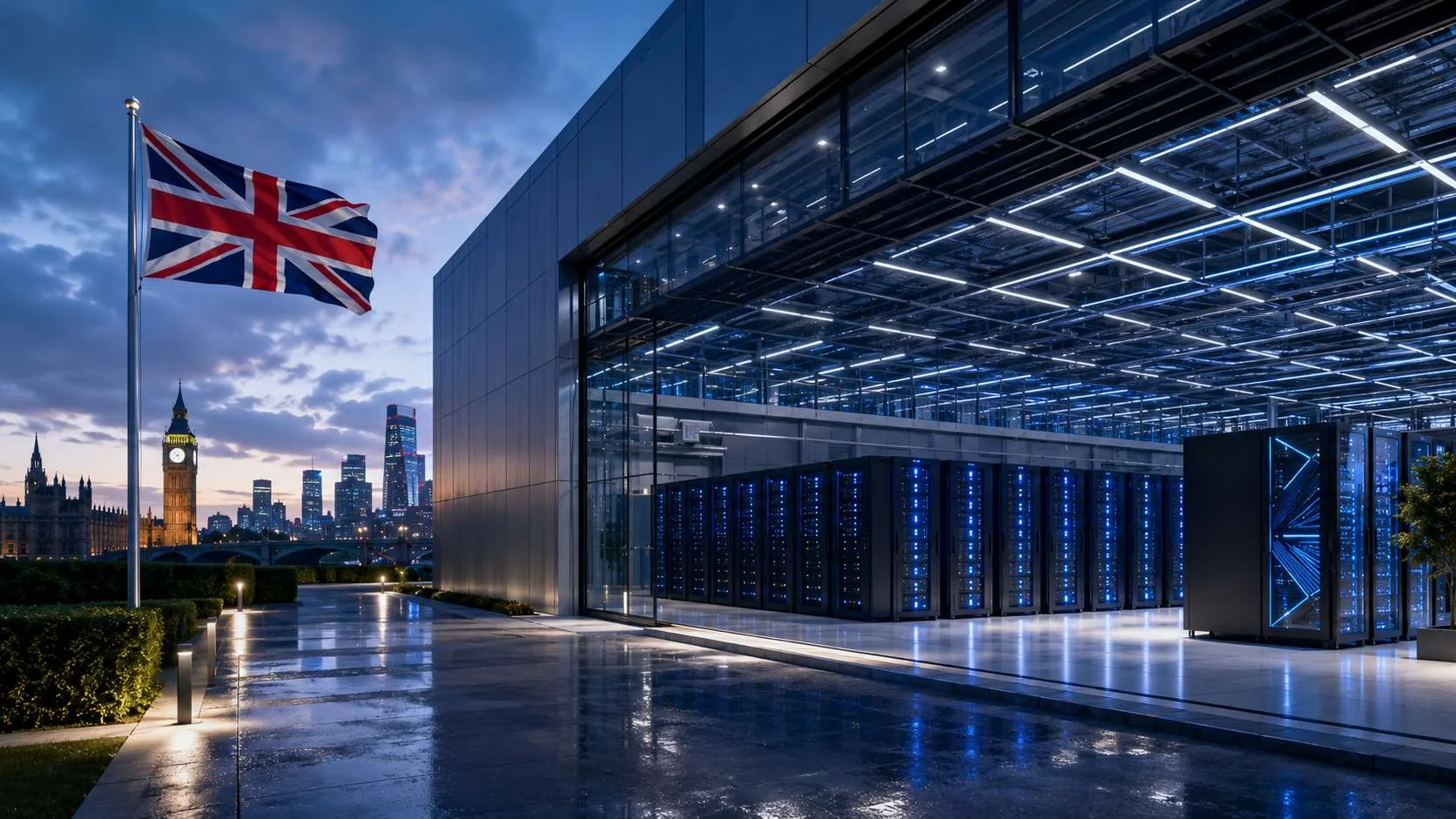
The United Kingdom has committed approximately US$1.47 billion to construct a national supercomputer dedicated to artificial intelligence, a move that positions the country among the leading players in the global race for advanced computing. Announced Tuesday as part of a wider strategy, the initiative seeks to curb reliance on foreign infrastructure and cement Britain's status as a technological powerhouse. Authorities described the capacity to process massive datasets and train sophisticated AI models as a strategic resource on par with energy grids or telecommunications networks. The investment underscores a pivotal moment where nations increasingly view computing power as a cornerstone of sovereignty and economic competitiveness.
A Bold Bet on Technological Sovereignty
The plan encompasses next-generation computing infrastructure, research hubs, semiconductor development, and advanced AI systems. At its core sits the national supercomputer, engineered to handle large-scale model training for scientific inquiry, industrial applications, government operations, and support for domestic startups and tech firms. Government officials emphasized that advanced computing has become a strategic asset comparable to energy or telecom networks, and that the new system will bolster British autonomy. The explosion of generative AI has dramatically reshaped the sector: modern models require immense computational power, with tens of thousands of processors working in parallel for months to analyze trillions of parameters.
The Global Race for Computing Power
Companies such as OpenAI, Anthropic, Google DeepMind, and Microsoft Research depend on extremely sophisticated infrastructure to develop their technologies. In this context, nations without their own computing capacity risk becoming dependent on foreign platforms—a risk that motivated the UK's decision. The announcement did not occur in isolation: over the past two years, several powers have launched similar programs. The United States continues to lead, buoyed by giants like NVIDIA, Microsoft, Amazon, Google, and OpenAI, while China invests billions in supercomputing and proprietary chips to circumvent Washington's technology restrictions. The European Union, through its EuroHPC initiative, is also funding next-generation supercomputers across the continent.
Transforming Science and Industry
The concept of technological sovereignty was repeatedly invoked during the announcement, reflecting a view that advanced computing is a national strategic resource. Governments now see excessive dependence on infrastructure located abroad as a threat to national security, privacy, economic competitiveness, and scientific autonomy. By building its own supercomputer, the UK aims to reduce this vulnerability. Artificial intelligence sits at the heart of the project: officials believe its impact could be comparable to that of electricity or the internet on the global economy. AI is already transforming sectors such as:
- Health
- Education
- Finance
- Defense
- Scientific research
- Industry
- Energy
- Logistics
The supercomputer is expected to accelerate research in these fields and grant British institutions access to computing resources on par with the world's largest organizations. Universities including Oxford, Cambridge, Imperial College London, and University College London—among the most respected globally—currently face limitations in accessing the infrastructure needed for advanced experiments. With the new system, scientists will be able to run more complex simulations, analyze massive data sets, and develop novel AI models.
An Ecosystem for Innovation
Another goal of the program is to strengthen the UK's innovation ecosystem. Startups often struggle to compete with technology giants due to the high cost of computing required for AI. By providing national computing resources, the government hopes to encourage the emergence of new companies capable of competing internationally. Experts note that access to infrastructure may become as important as access to financial capital. The plan also includes investments in semiconductors, considered the central element of the modern digital revolution—without them, it would be impossible to build supercomputers, smartphones, autonomous vehicles, or advanced AI systems. The pandemic and geopolitical tensions have exposed vulnerabilities in global supply chains, reinforcing the need for national investments.
The Road Ahead: Engineering and Energy Hurdles
Despite the enthusiasm, the program faces significant challenges. Building and operating modern supercomputers requires:
- Abundant electrical power
- Advanced cooling systems
- Highly skilled specialists
- Constant hardware upgrades
- High operational costs
Moreover, the rapid pace of technological evolution may demand new investments even before the project is fully completed. The British government believes the investment can generate substantial returns for the national economy, especially since AI already moves hundreds of billions of dollars globally and its contribution to world GDP could reach trillions in the next decade. By investing early, the UK hopes to attract companies, researchers, and international capital. The decision reinforces a global trend of transforming advanced computing into critical infrastructure, similar to what governments historically did with highways, railways, airports, and power grids. Beyond AI, the supercomputer will be used in a variety of scientific areas such as:
- Climate modeling
- Drug discovery
- Genetic research
- Physical simulations
- Astronomy
- Nuclear fusion
- Materials science
These applications demand enormous computing capacity and often rely on high-performance systems. The project represents another chapter in the international contest for technological leadership: as AI becomes more powerful, the infrastructure needed to develop it takes on an increasingly strategic role. The national supercomputer announced by the UK could become one of the country's most important technology assets over the coming years, strengthening its position in the digital economy and helping to define the global balance of power in an era driven by data, algorithms, and artificial intelligence.