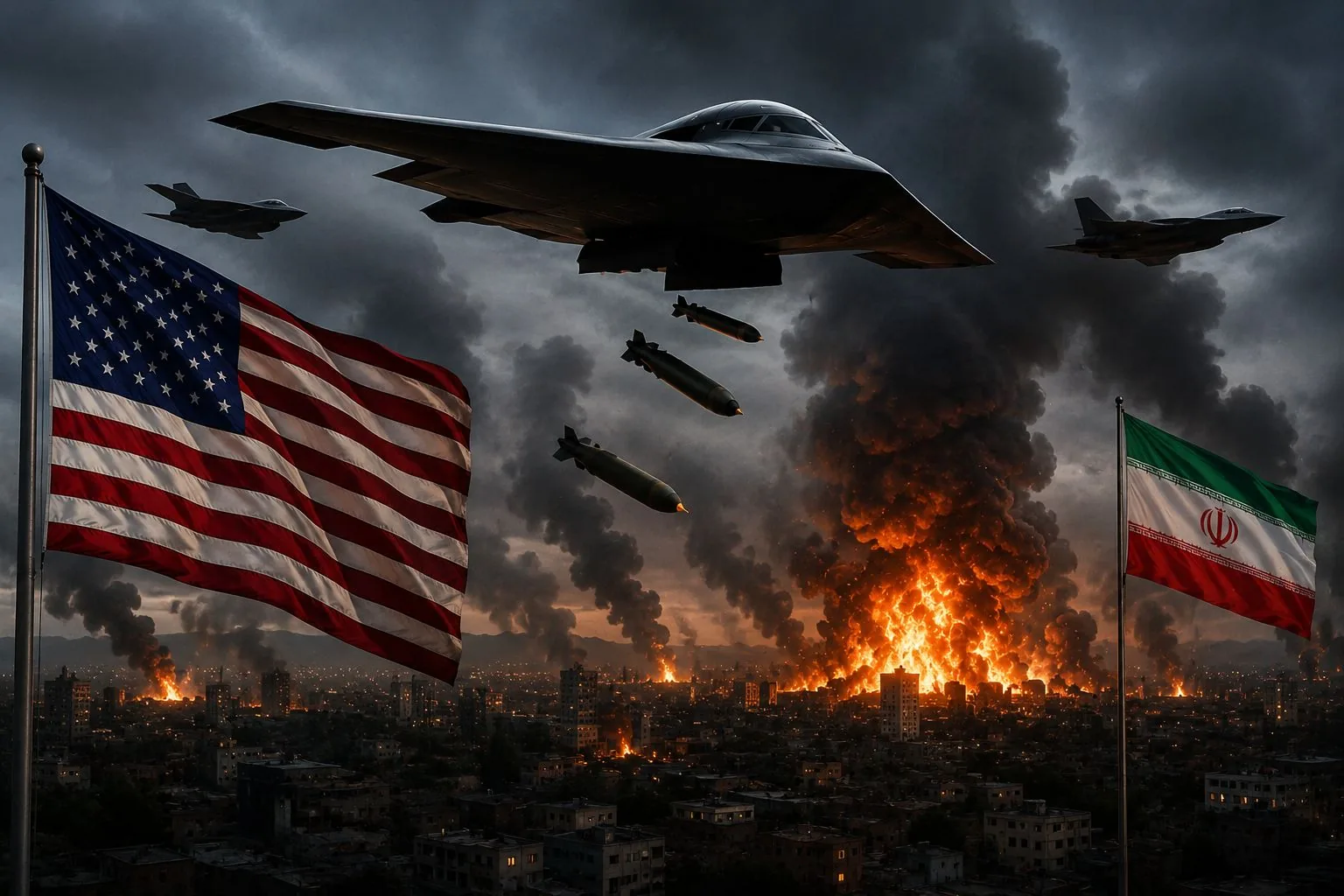
The United States launched self-defense strikes against Iran on Tuesday (June 9), responding to the downing of a US Army AH-64 Apache helicopter, according to a statement from US Central Command (CENTCOM). The operation began at 6 p.m. Brasília time under direct orders from the commander in chief and was characterized as a “proportional response to Iran’s unjustified aggression.” Although the full scope and intensity of the bombings remain unclear, the move marks a sharp escalation in hostilities between the two nations. The incident comes just one day after the Apache was shot down while patrolling the Strait of Hormuz, endangering one of the world’s most strategic maritime chokepoints.
Response Under the Banner of Self-Defense
CENTCOM emphasized that the strikes were an immediate reaction to the downing of the Apache, which occurred off the coast of Oman. In a post on the social media platform X, the command described the mission as a “proportional response,” referencing a
update. President Donald Trump also weighed in via Truth Social, stating that he had been briefed by the armed forces on the shoot-down and that the United States “must, necessarily, respond to this attack.” The language used by the administration suggests it views the incident as a deliberate hostile act rather than an accident, reinforcing the justification for military retaliation.
Presidential Confirmation and Pilot Safety
In his Truth Social post, Trump detailed the events that triggered the US response. He claimed that Iranian forces shot down “one of our sophisticated Apache helicopters” while it was patrolling the Strait of Hormuz the previous night. The president confirmed that both pilots aboard were “safe and unharmed” after being rescued by an American maritime drone. This marks the first loss of an Apache since the onset of the conflict with Iran, a milestone that intensifies pressure on Tehran and, in the White House’s view, warrants immediate retaliation. The rescue operation highlights the military’s capability to recover personnel even in contested waters.
Explosions Rock Southern Iran
As the US strikes unfolded, Iranian news agencies began reporting explosions near the country’s southern coastline. The Mehr news agency, citing local residents, said that loud booms were heard in the Sirik region, though the nature of the noises remained unknown at the time. Meanwhile, the semiofficial Fars news agency stated that blasts also occurred in parts of eastern Hormozgan Province. These reports suggest that the bombing targets may be concentrated in southern Iran, close to the Strait of Hormuz, but there has been no official confirmation regarding exact locations or damage. The lack of detailed information fuels uncertainty about the scale of the operation.
Tehran Fires Back With Warnings
Iranian Foreign Minister Abbas Araghchi quickly responded to the accusations and the US strikes, urging foreign forces to leave the Strait of Hormuz. In a post on X, Araghchi warned that forces near Iranian territory “run a constant risk due to human error, accidents, or of potentially being caught in crossfire.” He added that the “best solution” is the immediate withdrawal of foreign forces from an environment that “will never be hospitable to a hostile presence.” Despite the strong rhetoric, Araghchi stated that Tehran prefers “the language of diplomacy,” but he also noted that “we also know how to speak other languages.” This remark echoes previous statements by top Iranian negotiator Mohammad Bagher Ghalibaf, signaling a dual approach of diplomatic overture and military readiness.
Dispute Over the Strait of Hormuz
The Iranian foreign minister also challenged the legal status of the Strait of Hormuz, arguing that the area is not international waters but rather jointly shared by Iran and Oman. He promised that the Iranian armed forces remain on constant alert for “any violation of Iran’s airspace, territory, or territorial waters.” This position directly contradicts the US narrative, which views the strait as an international waterway where American aircraft have the right to patrol. The disagreement over the strait’s jurisdiction is a central point of friction. The downing of the Apache and the subsequent “self-defense” strikes represent the first loss of such an aircraft since the conflict began, a fact that could further harden Tehran’s stance.
The events underscore a rapidly deteriorating security situation in the region. The Strait of Hormuz is a vital artery for global oil trade, and any sustained hostilities could disrupt shipping and drive up energy prices. Both Washington and Tehran appear to be digging in, with the US insisting on its right to patrol and Iran defending its claimed sovereign boundaries. The international community now watches closely for any further military moves or diplomatic openings that might de-escalate the crisis.